Diary of a man and his woodland

A blog about a man's dream to own a small woodland.


Leave a comment

Logs, ladybirds and a new toy for the woods

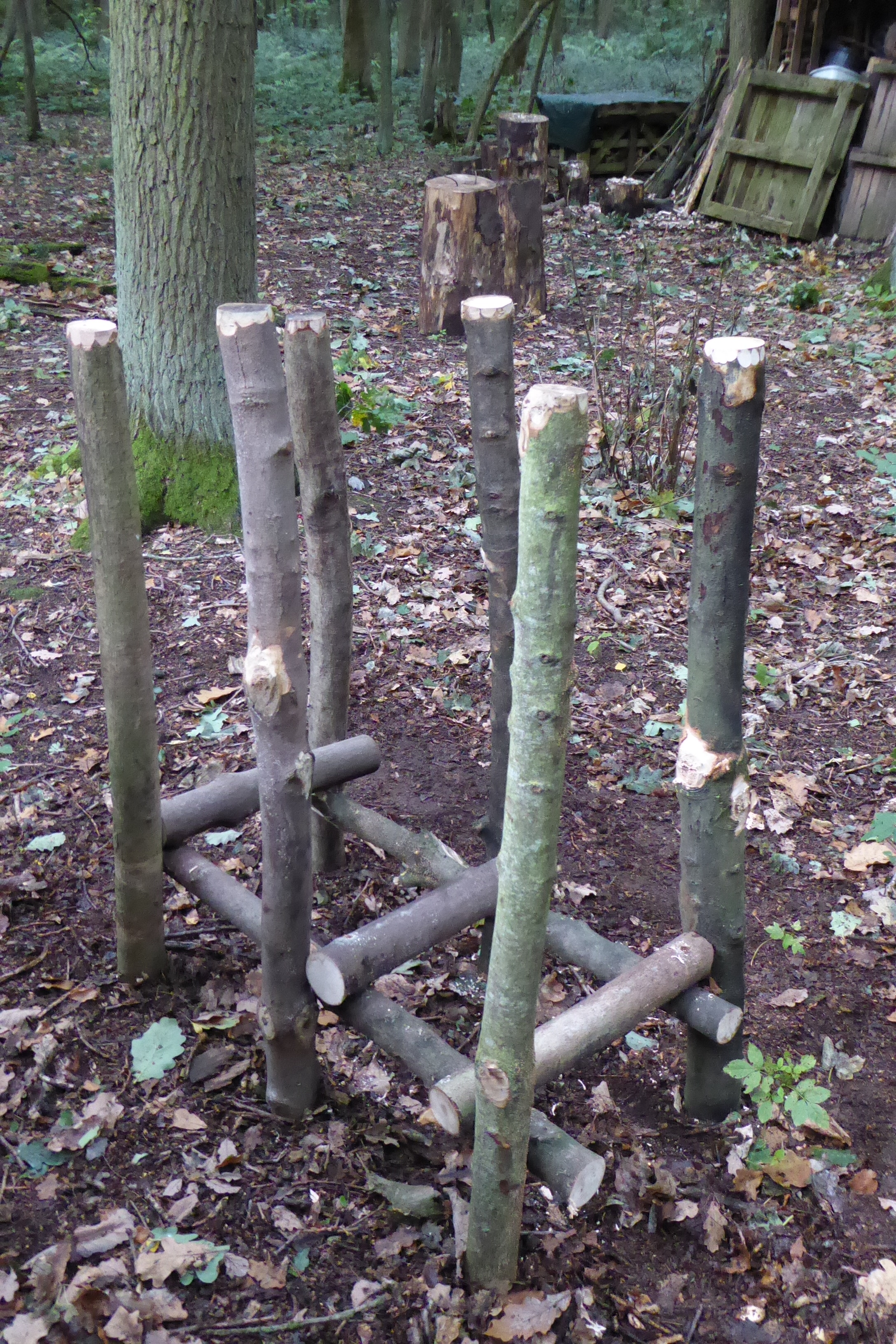
The woods are starting to show that autumn is here. Ferns are dying back and there were acorns on the ground after the recent gales. I rarely find any because the squirrels and mice beat me to them but I managed to find a handful that I can plant up at home. My neighbours have kindly found a buyer for some of my logs so first job was to bag some up. The money from them will go towards new tools and fuel for the machines. The other log related topic was the building of a saw frame. You can stack several small to medium sized branches in it, then using the chainsaw, cut through the whole pile in one go into log-sized pieces ready for stacking. That should speed up the processing of felled trees. The trick is to stop cutting before I reach the lower bearer poles!

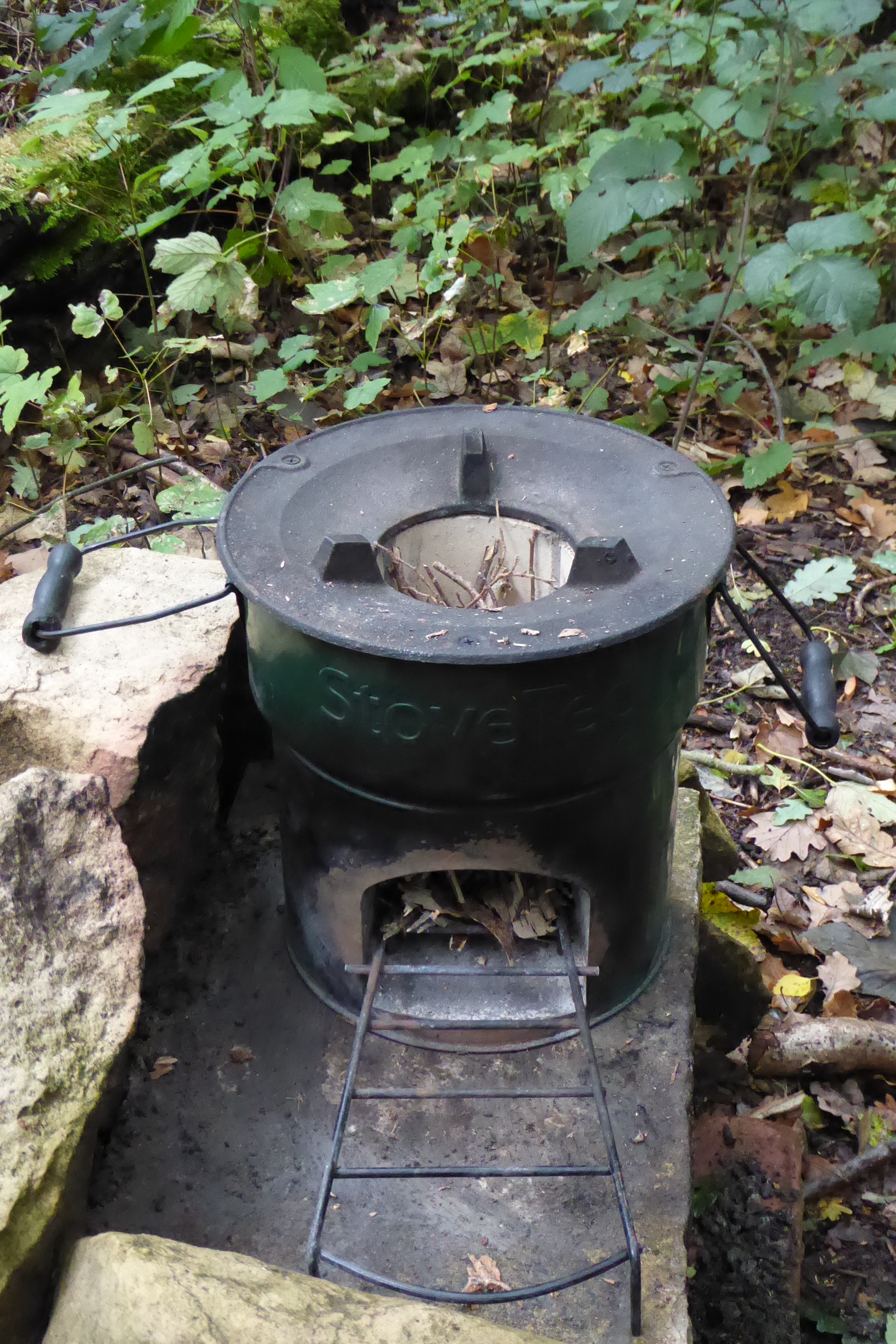
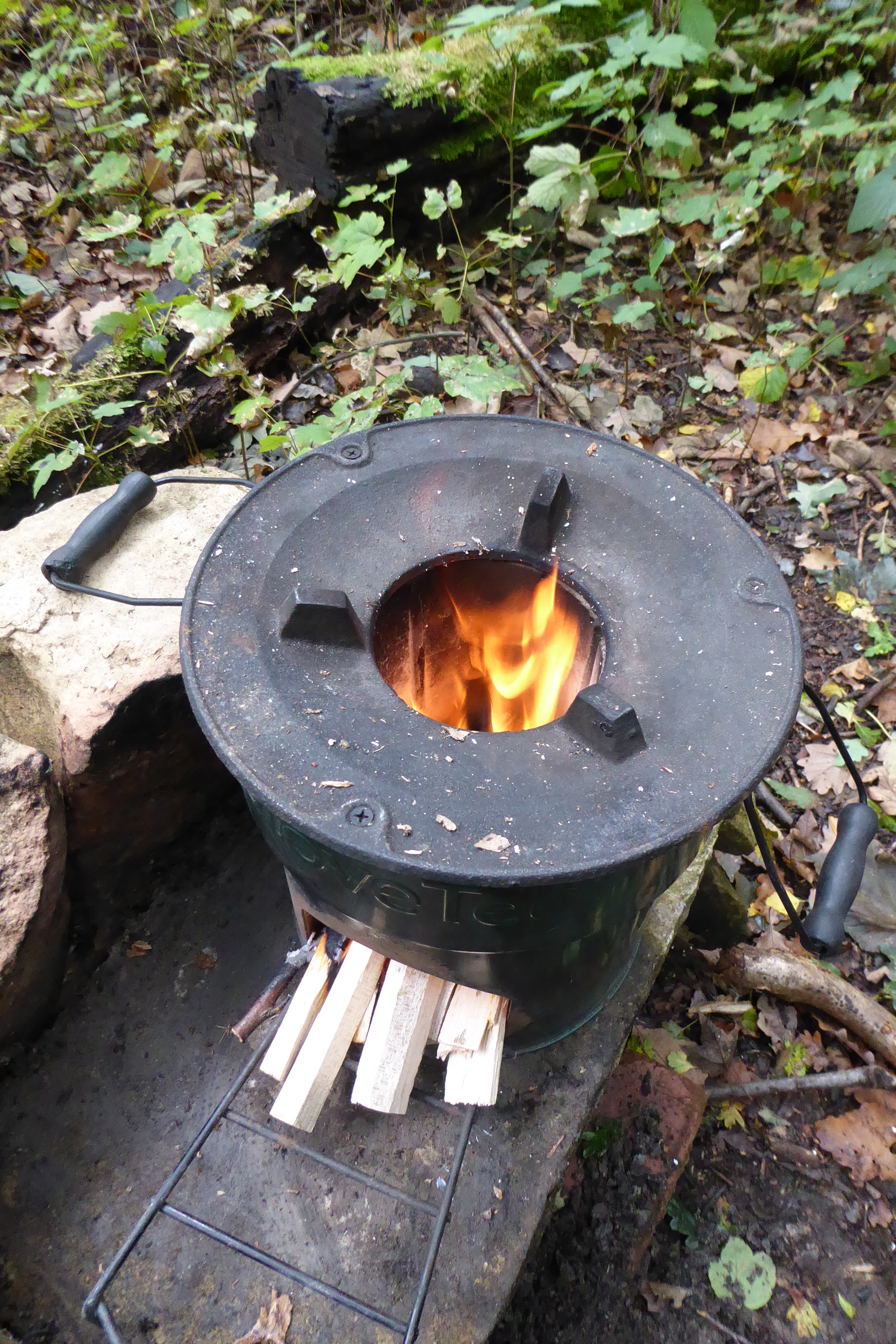
Lunch was a fried egg sandwich. This was the fun part of the day. One of my pals had very kindly given me a rocket stove which I wanted to try out. He is downsizing and had a spare one. Apparently they were designed to help third world countries. The simple design uses small sticks for fuel which are either fed through the top or the opening at the bottom. It’s very efficient and works by convection. The heat of the flames rising up the chimney draws more air into the bottom opening, creating a strong flame and little smoke. It’s basically a metal bucket with a fireproof clay liner and a cast iron top to support a pan or kettle. Very sturdy and easy to use. Some strips of birch bark as tinder and small sticks started the initial fire, then I dropped more sticks down the chimney until there was enough hot embers to feed larger sticks in from the side. It was ready to start cooking in about 10 minutes.

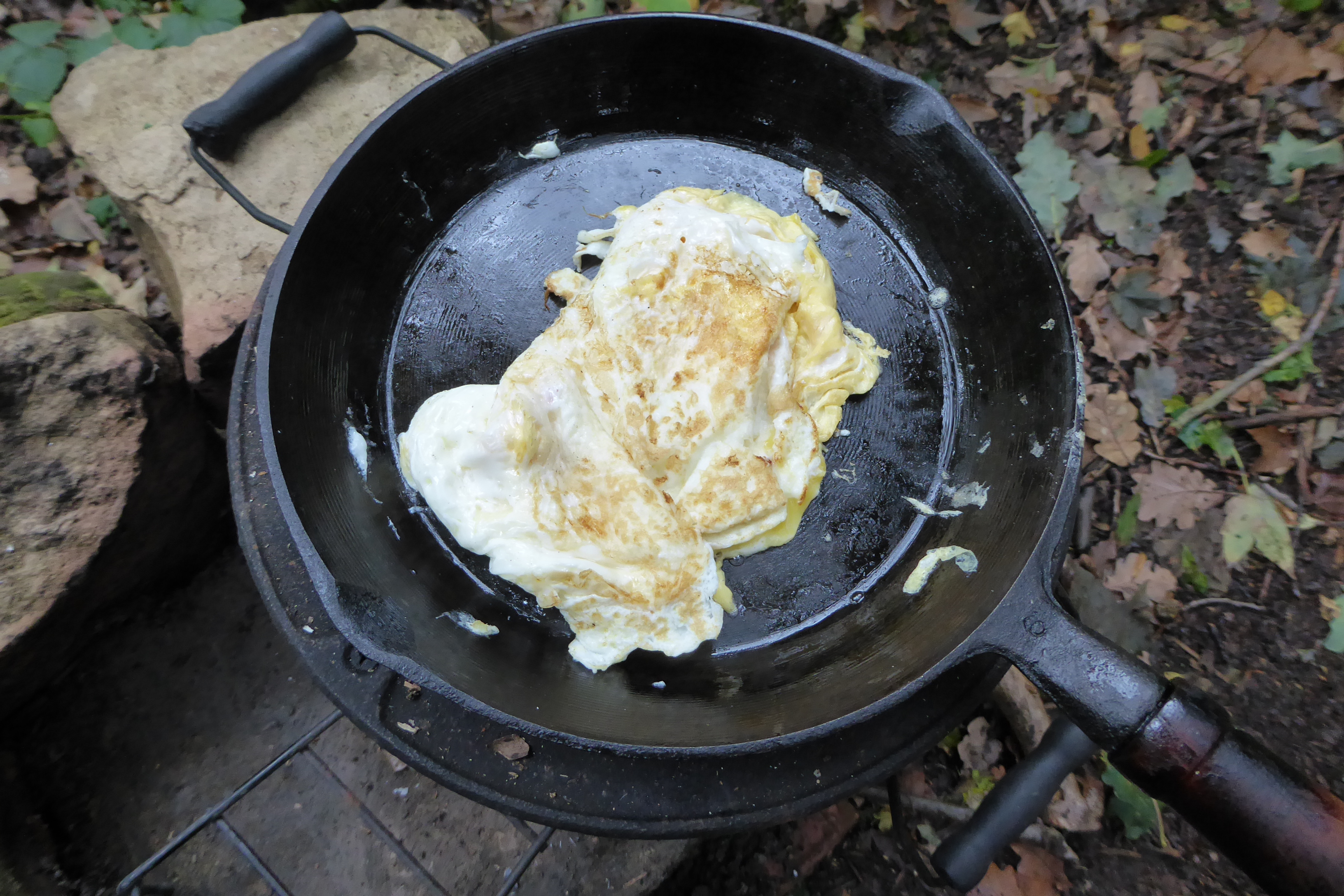
Time to get the skillet hot and cook my eggs. I prefer the yolks broken for a sandwich, otherwise I end up with it oozing out the sides and down my shirt. I have to say the cast iron skillet works a dream over a hot fire and it cost me just £1 at a car boot sale. It was in a terrible greasy condition but they are easy to restore and worth the effort. Normally a smashed egg cooked over a very hot flame is a recipe for a hard to remove mess but not with the skillet. A rub over with a piece of kitchen roll and it was as clean as a whistle. The rocket stove is fantastic and will be used when a campfire is too much trouble or when wet weather confines me to the shelter.

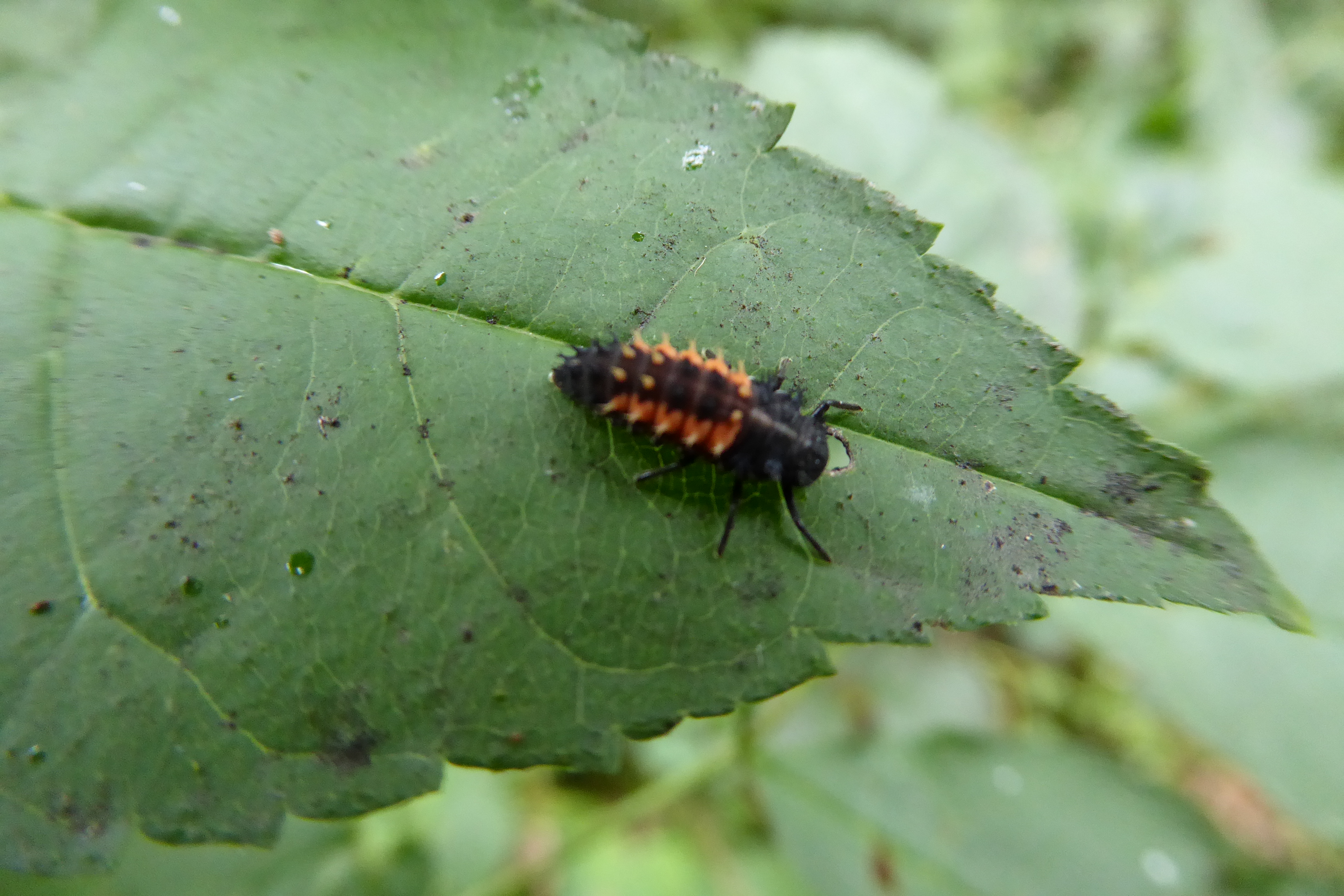
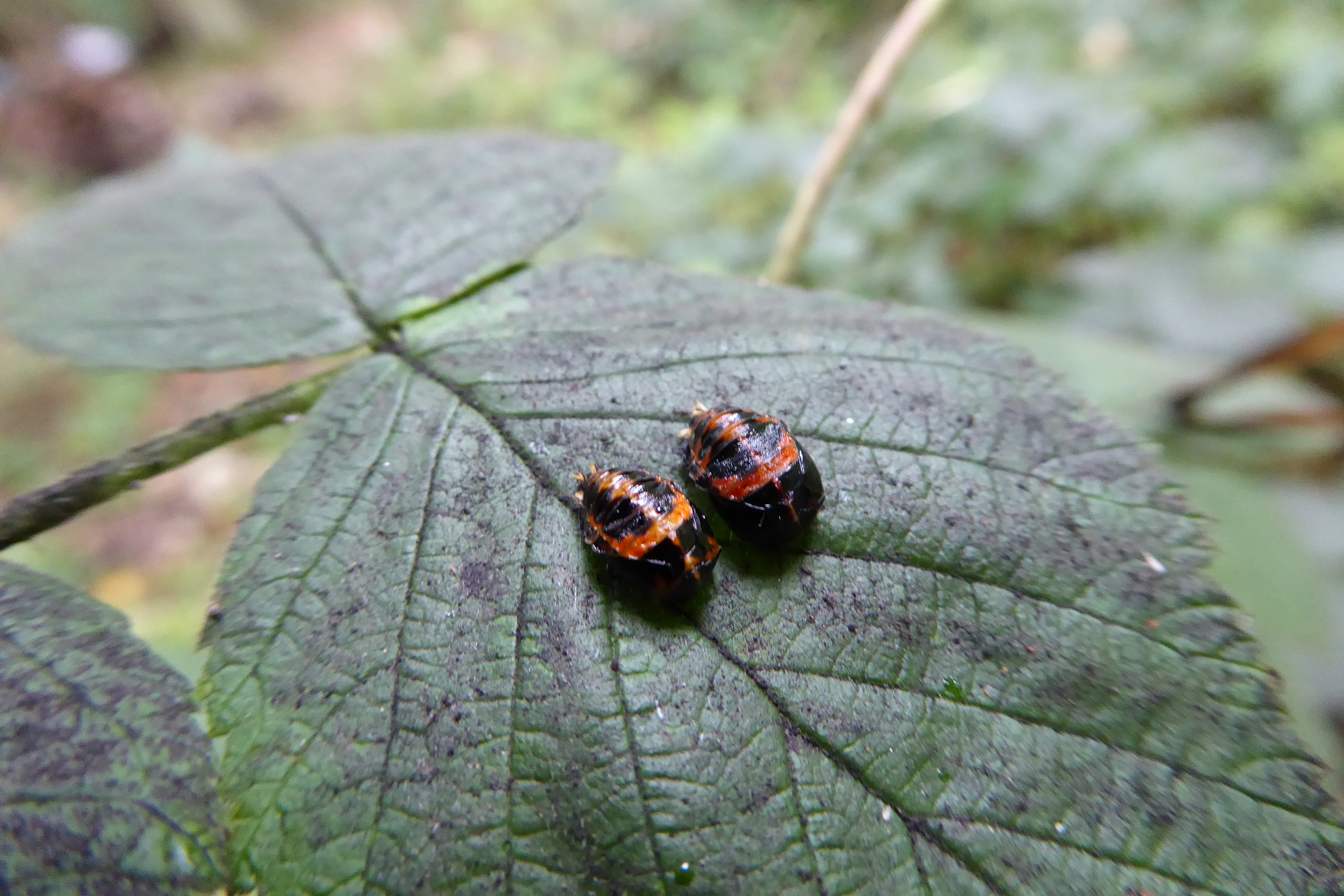
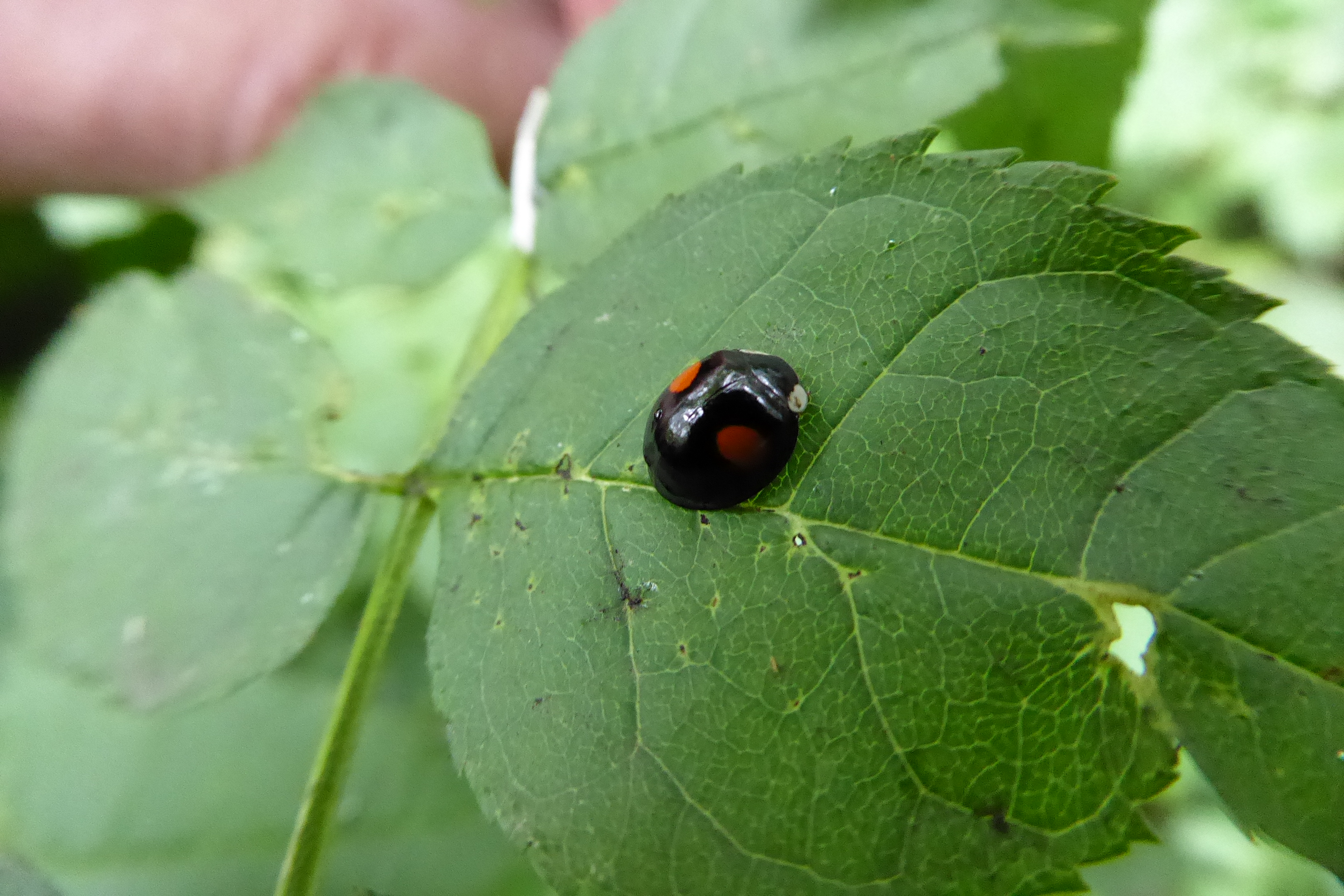
During a walkabout with my neighbour, we started spotting lots of ladybirds. The area was full of bramble, nettles and wild raspberries, so presumably they like those plants. Sadly my research suggest that they were mainly of the Asian Harlequin varieties which are invading the uk and a threat to our native species. Some were still at the nymph stage, some were metamorphosising into adults. I’ll end here with some photos of the different stages. Sorry the nymph photo below is a bit blurred but it was hard to keep the camera still at such close range.

two nymphs at metamorphosis stage

adult two-spot Harlequin ladybird


Leave a comment

What goes on in the woods when I’m not there. Shelter finished.

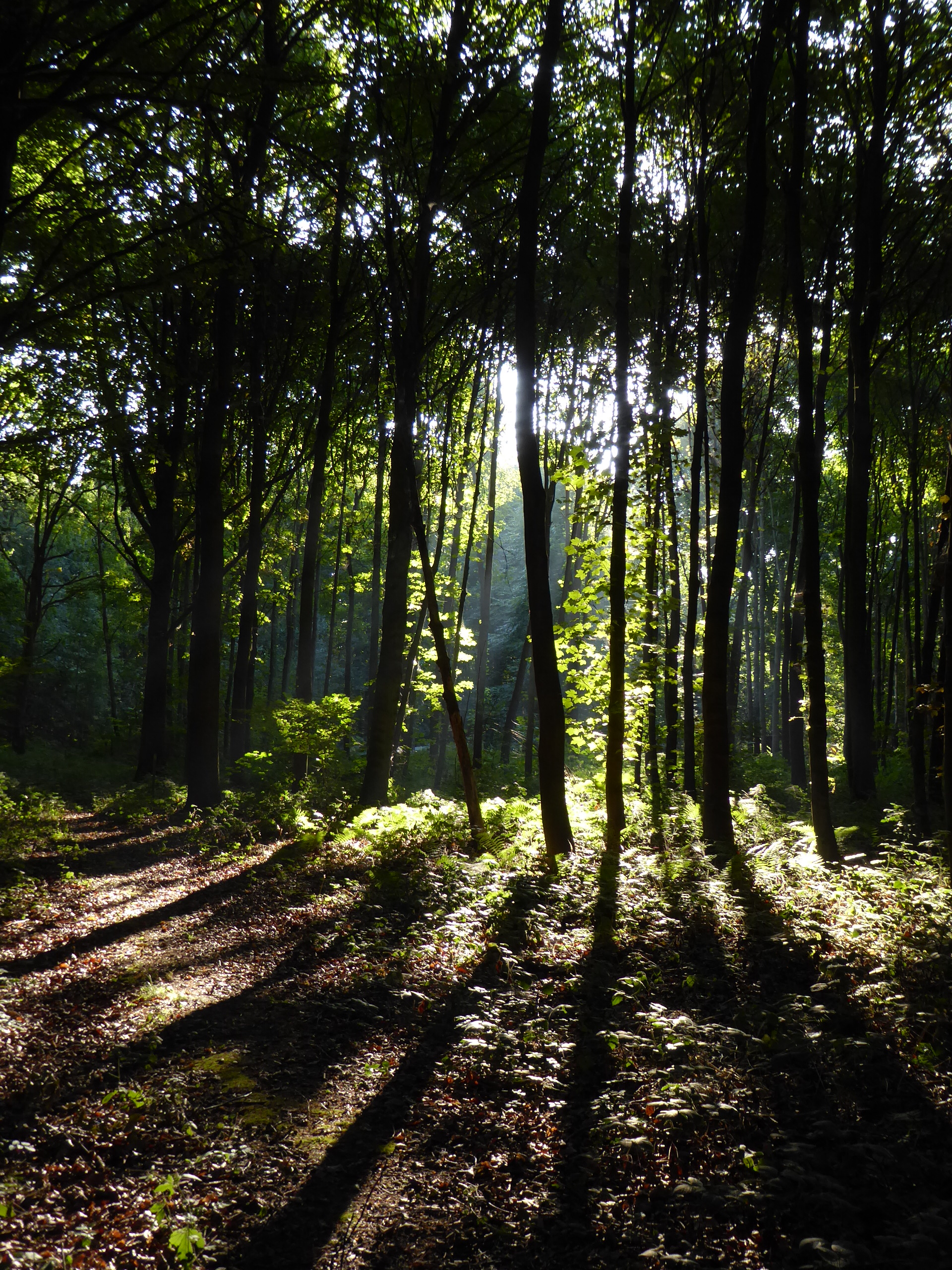
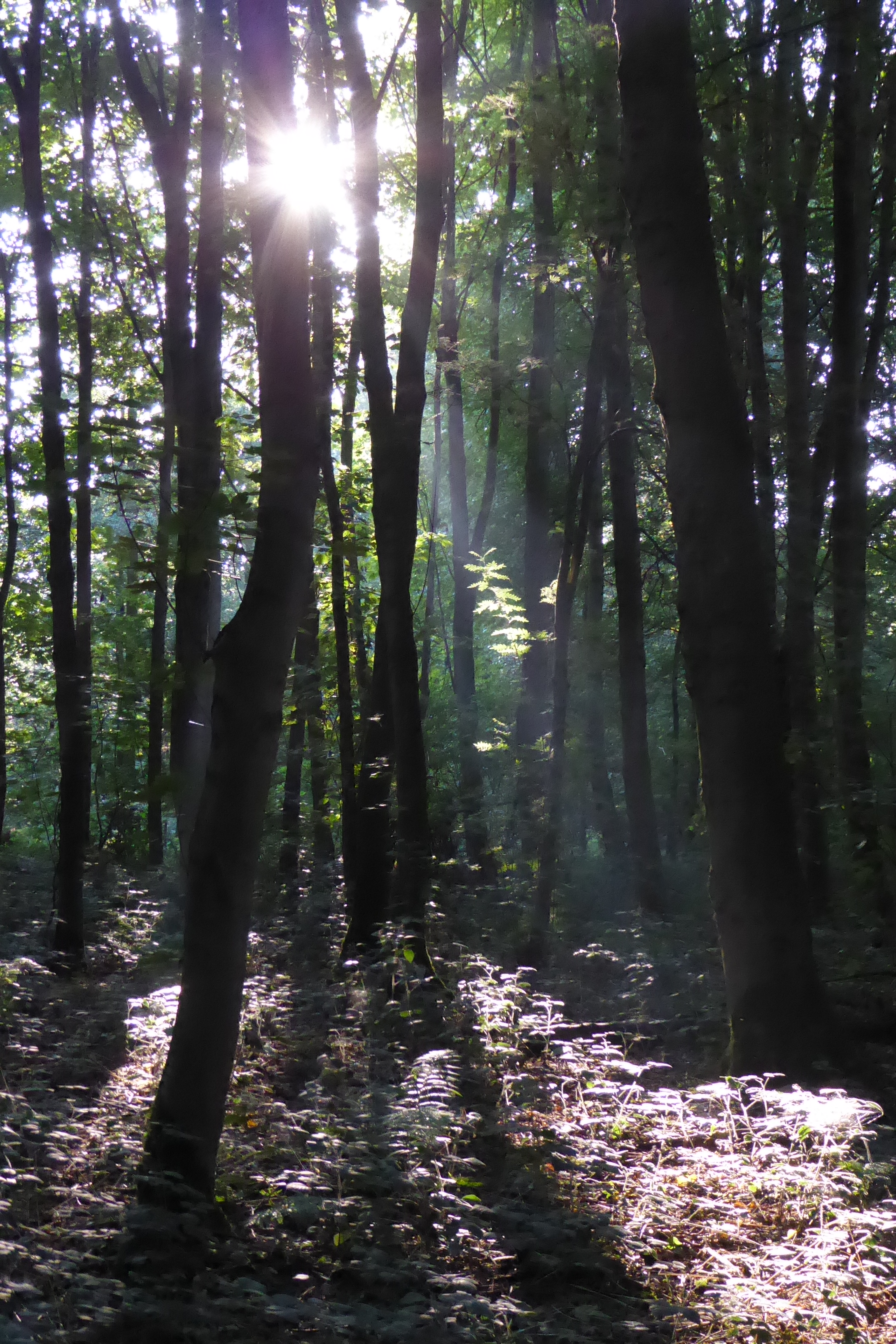
A lovely morning, sun streaming through the trees, what a fantastic place to be at 8am. Jobs for the day – collect some logs for home, finish the shelter rebuild and check my trail camera. Last visit, I set the camera up and was keen to see the results. I placed it in an area I use a lot, facing the junction of two paths. I figured that larger animals like badgers, foxes and deer will use paths for the same reason we do – it’s easier to get around. The camera has infra red sensors, two facing out from the sides and one in front. When something triggers it, I have it set to record for 15 seconds. Sometimes there will be nothing on the video, I think that’s due to a fast moving object like a bird passing by. The camera showed 58 video captures so that was promising. I eagerly trawled through each one. I estimate about 35 of them are of a grey squirrel. Not my favourite wildlife subject but nevertheless, it was interesting to see how much a creature of habit it is. The camera was under some oak trees which are shedding a few acorns and Mr or Mrs Grey obviously likes that restaurant. It would forage, then run off to a nearby log to sit and eat it.  Another few shots were wood pigeons – still pretty dull. But one shot made me smile, it showed a huge toad leaping through the air then plopping onto the ground as if someone had just thrown it into the frame. A night shot showed a tiny creature running along, only visble by the reflection from it’s retina. But the bonus shot and one I was hoping for was a fox. Just a few seconds as it walked left to right across the view.

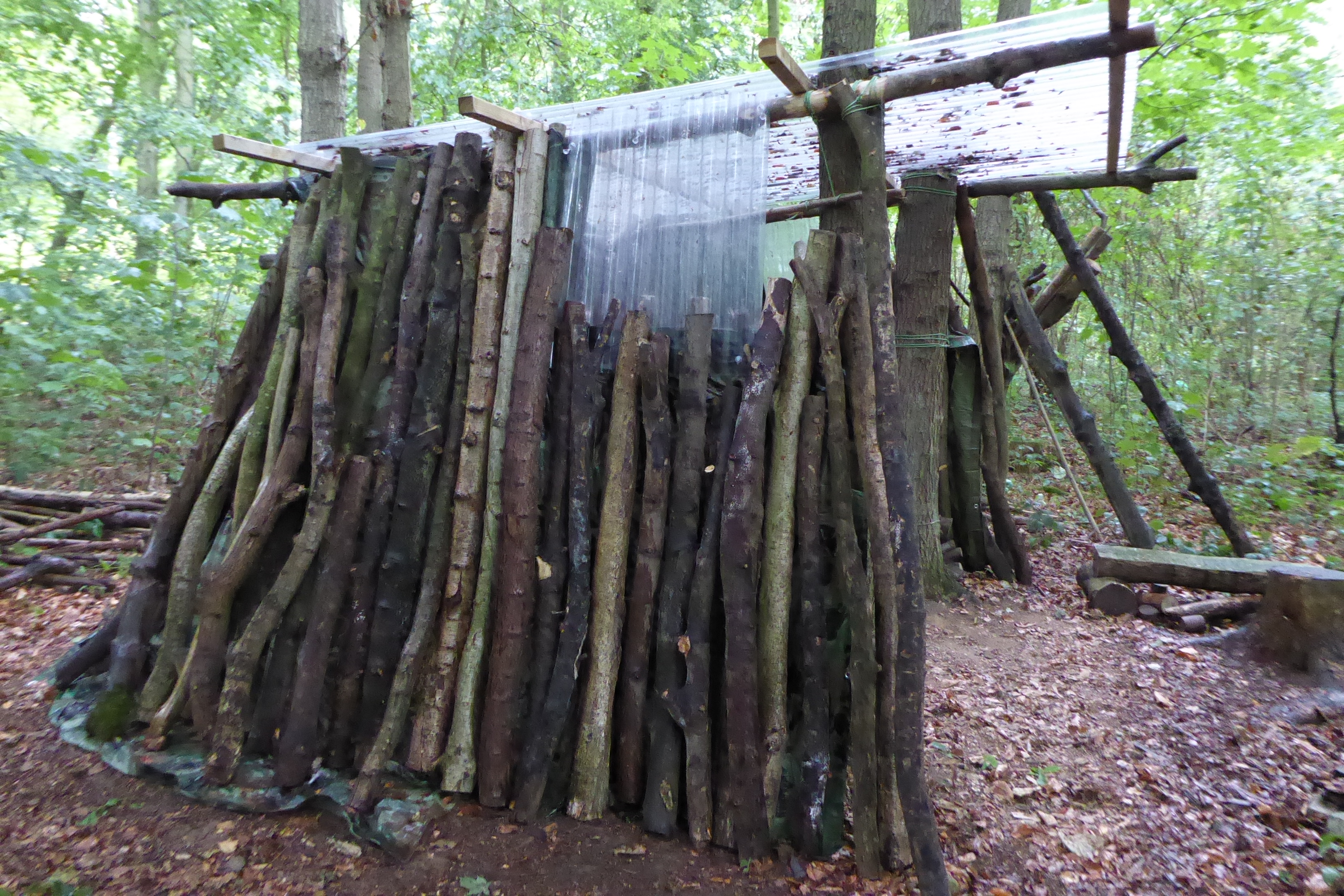
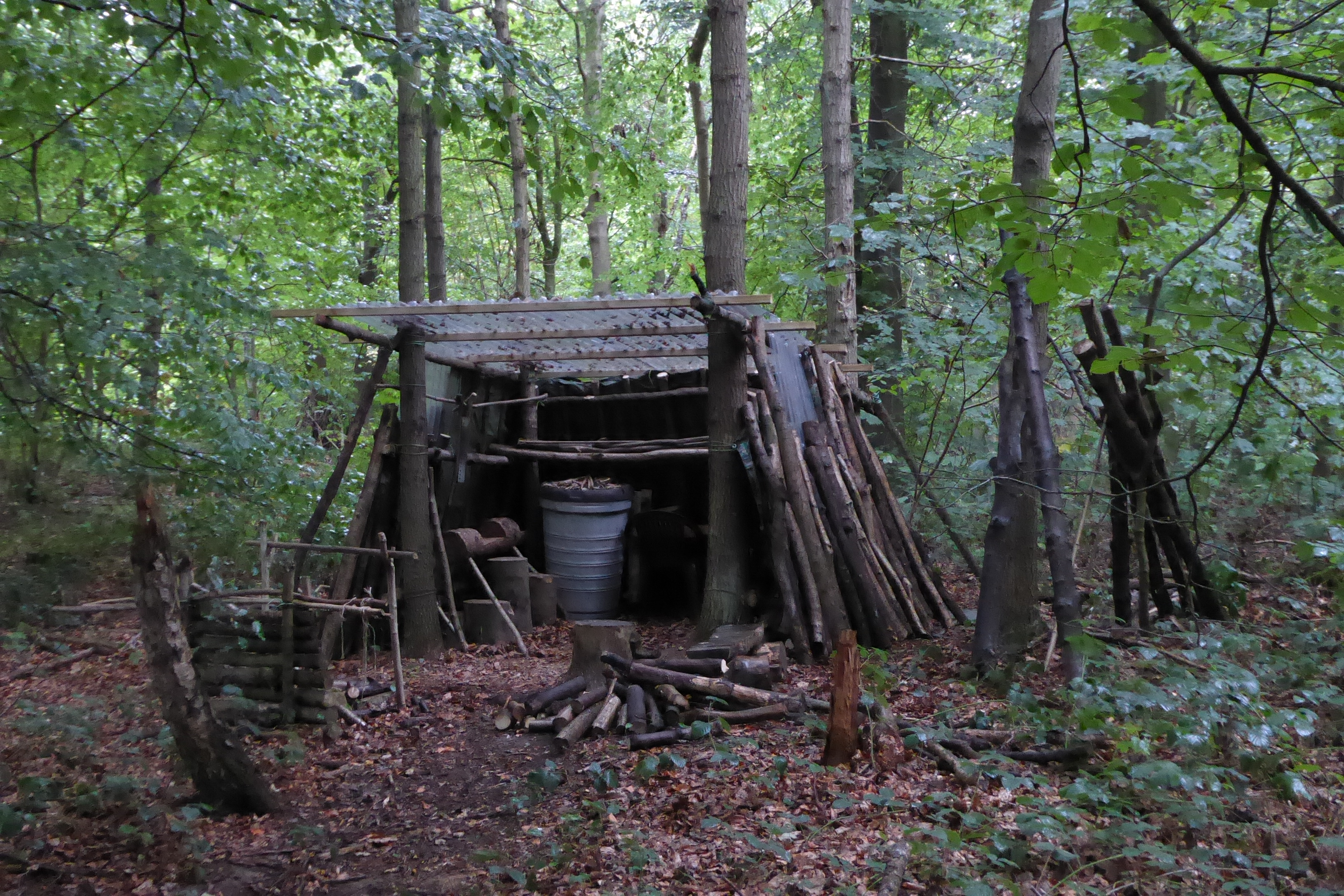
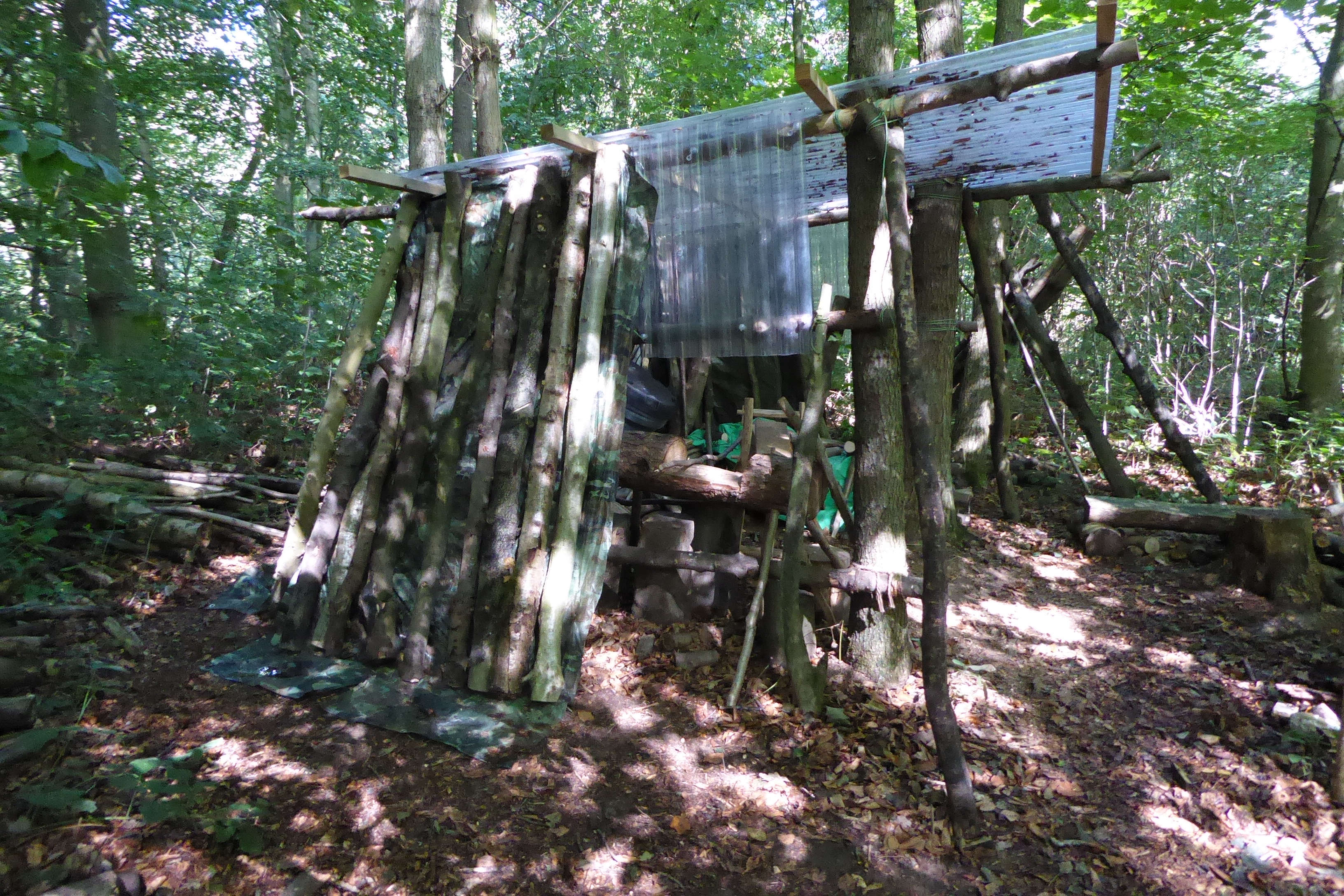
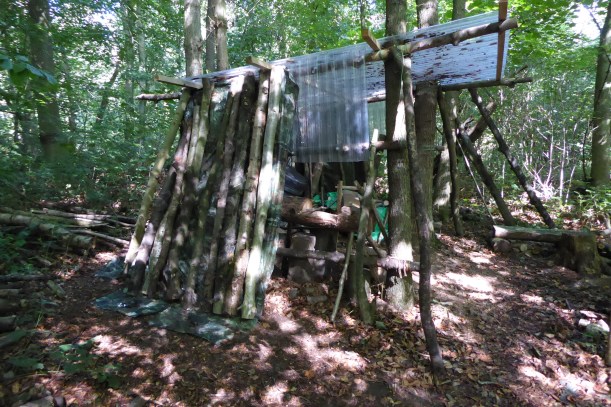
Most of the morning was spent finishing my shelter. I’d bought another piece of plastic camo tarp to cut in half and line the front half of the sides. Basically I built rough frames from logs for the walls, covered them in the tarps, then covered the tarps on the outside with more logs. So the tarp is sandwiched between the logs to provide a waterproof membrane. The logs stop it blowing around and protect it plus help it blend into the surroundings.

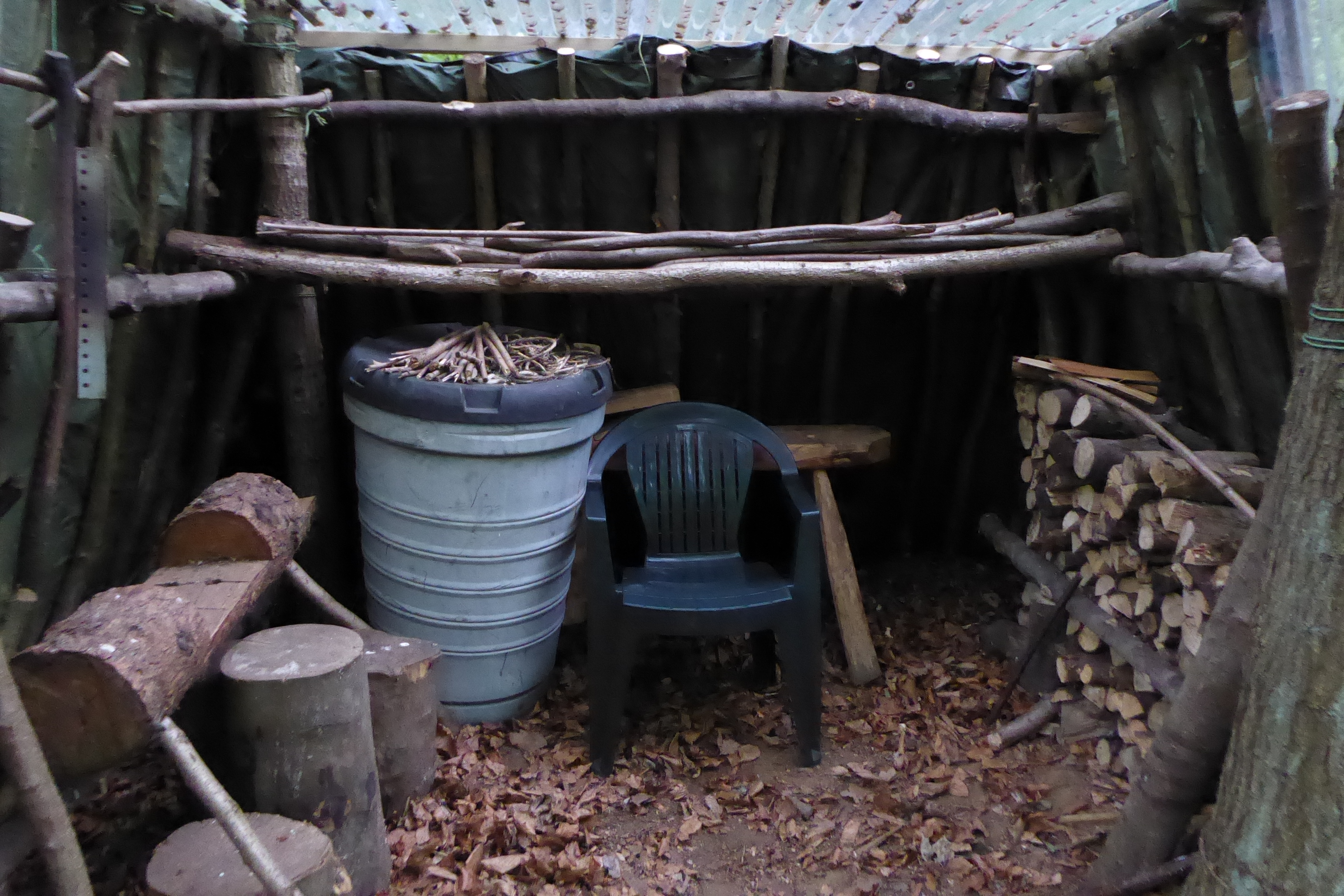
It’s main purpose is a place to escape to when it rains. I can just sit and enjoy the experience or maybe do a bit of green woodworking. It’s a winter campfire site if I want to warm up and maybe cook a little something for lunch. I was about to try it out. Rain was forecast for midday and darkness and gloom foretold it’s arrival. I had just finished the sides when it came down. I took the opportunity to do some housekeeping, tidying up my firewood pile and organising the space. It needs a few finishing touches –  the water butt will go outside when I have fitted a gutter on the back of the roof. Maybe a shelf across the back where the long logs are piled and one or two “woodland ornaments”. It’s comfortably roomy for two people to sit with a coffee or for me to use the shavehorse for woodworking.


Leave a comment

September, warm and mellow

It was Saturday the 1st September when I went. Apparently it is the start of the “meterological” autumn whatever that means. Personally I prefer the start of seasons to be governed by the earth’s orbit around the sun – the solstices and equinoxes. Something that has been acknowledeged for centuries rather than some new fangled idea dreamt up by a bunch of weather readers! Apparently it’s based on average seasonal temperatures rather than astronomical motions and makes it easier to produce meaningful statistics. There you go, statisticians thinking they know best.

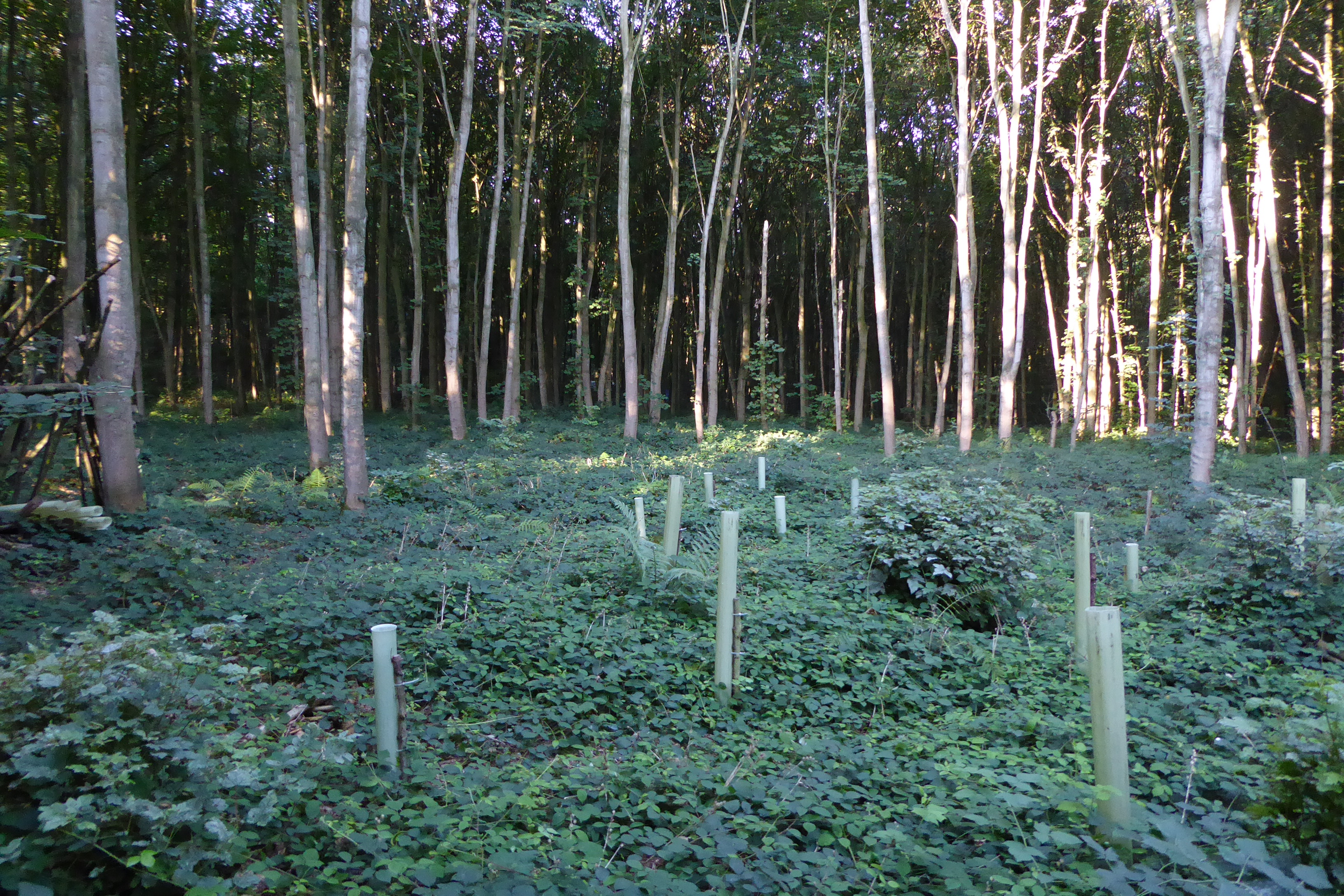
Well anyway it still felt like summer to me – warm, dry but starting to feel mellow now. The hawthorn trees in the countryside are laden with berries this year and there were lots of ripe blackberries to be seen. Now that’s a bit of a sore point because the newly cleared coup in the sycamore area that I cleared in winter, is now overgrown with brambles. The extra light has created a thick , criss-cross mat of bramble runners. So much so that I can’t walk around the saplings to check and water them.

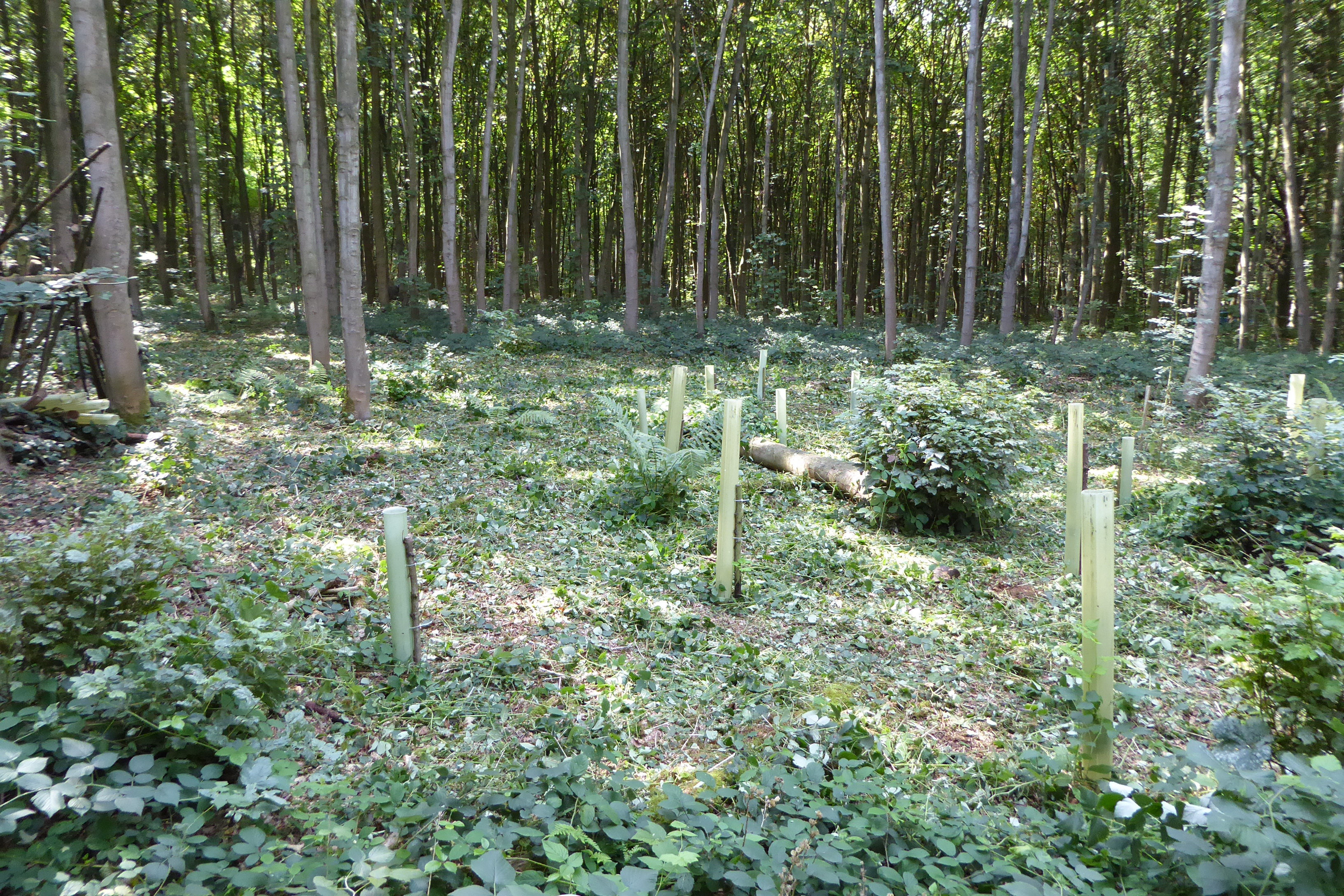
So armed with my heavy duty brushcutting machine, I set-to for an hour and roughly cut them down to th ground. They will return next year of course but hopefully weakened. This is the same area after my brushcutting session.

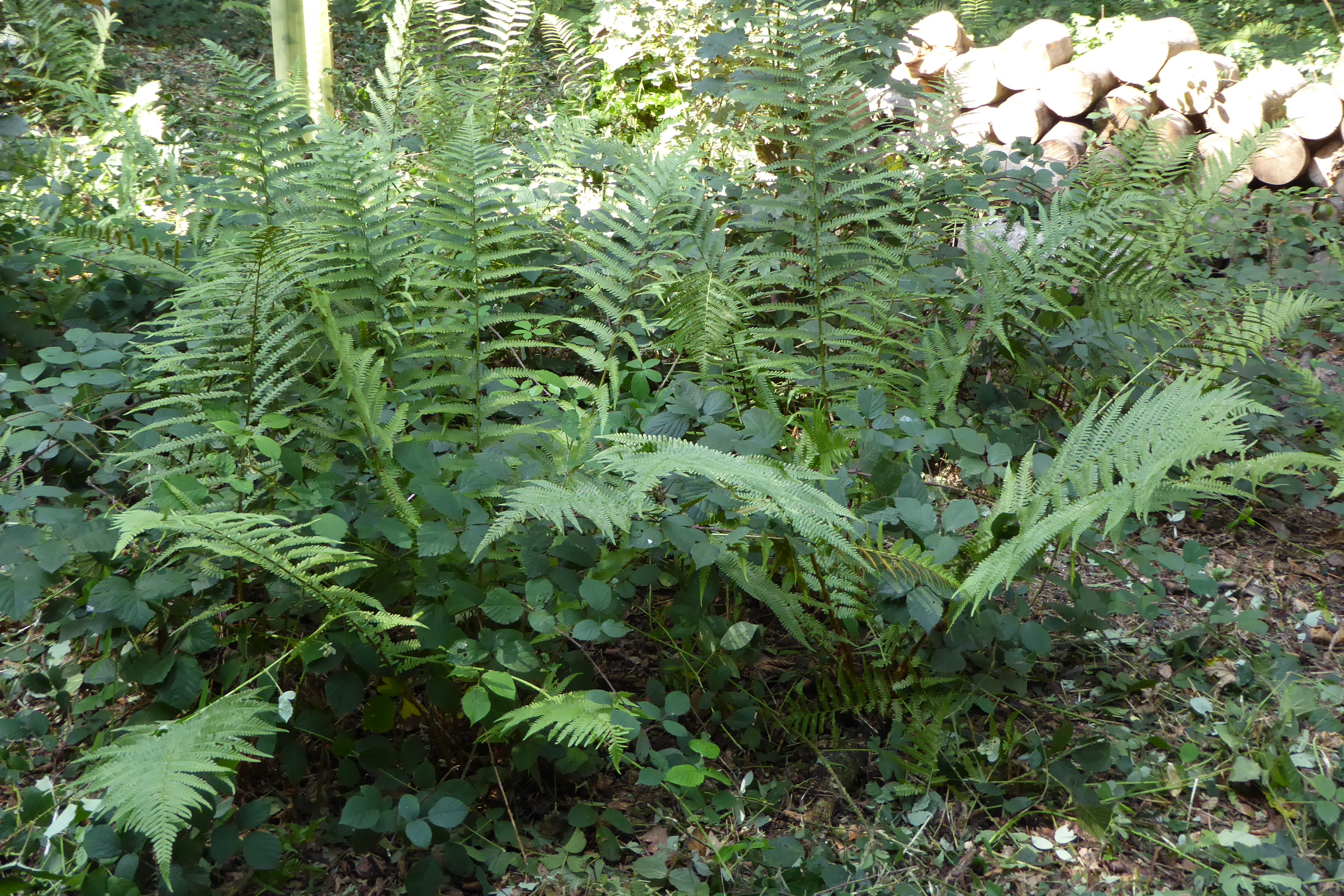
The cutting back last year has paid off and combined with extra light from felling some trees, the large ferns have done very well here and a number of naturally regenerated saplings are springing up – ash, wild cherry, hawthorn. Also some new patches of wood sorrel have appeared which I like very much. They are the plants that the Irish call Shamrock and the leaves taste of cooking apples. These species of fern (called Male Fern) are quite abundant throughout the wood.

My other main job was to bag up some dried, seasoned logs. My woodland neighbour has kindly offerd to take and sell them to a friend for me. Hopefully he will want some more. I have a surplus of logs and the small income will help pay for some overheads – fuel and oil for the chainsaw and my vehicle etc. I had hoped to do numerous jobs but as usual, time slipped away faster than I expected. I spent quite a while looking for a suitable spot for my wildlife trail camera. Up till now I have not really used it but a couple of other neighbours have had some fantastic shots on theirs. Roe deer, foxes, owls, buzzards, woodmice, hares, hedgehogs etc. I’m not confident that my camera will produce much when I return next. Tests done walking around it showed that it has a fairly limited range of about 5 metres for picking up movement. I’m hoping to go later this week to check it out.

Bird activity has dwindled. I guess the small songbirds like the chiff chaffs, warblers and blackcaps have returned to their mediterranean winter homes. The good old faithfuls – wrens, robins and various tits were around and I heard the loud yaffel call of a green woodpecker as it flew nearby. Still haven’t seen one close up yet though.

One last comment to make. One of my old pals, and a regular reader of this blog passed away last week. We used to exchange the odd email and meet up once a year for a pub lunch and a good old natter. His illness must have been lurking for a while but overcame him quickly. It always shocks me to realise that someone I knew pretty well, has just disappeared from existence. It serves to remind me too, how lucky I am to be the custodian of this fantastic place and to enjoy it and to enjoy the company of friends and family while I can. So goodbye John and thanks for your friendship.


1 Comment

Some campfire recipes

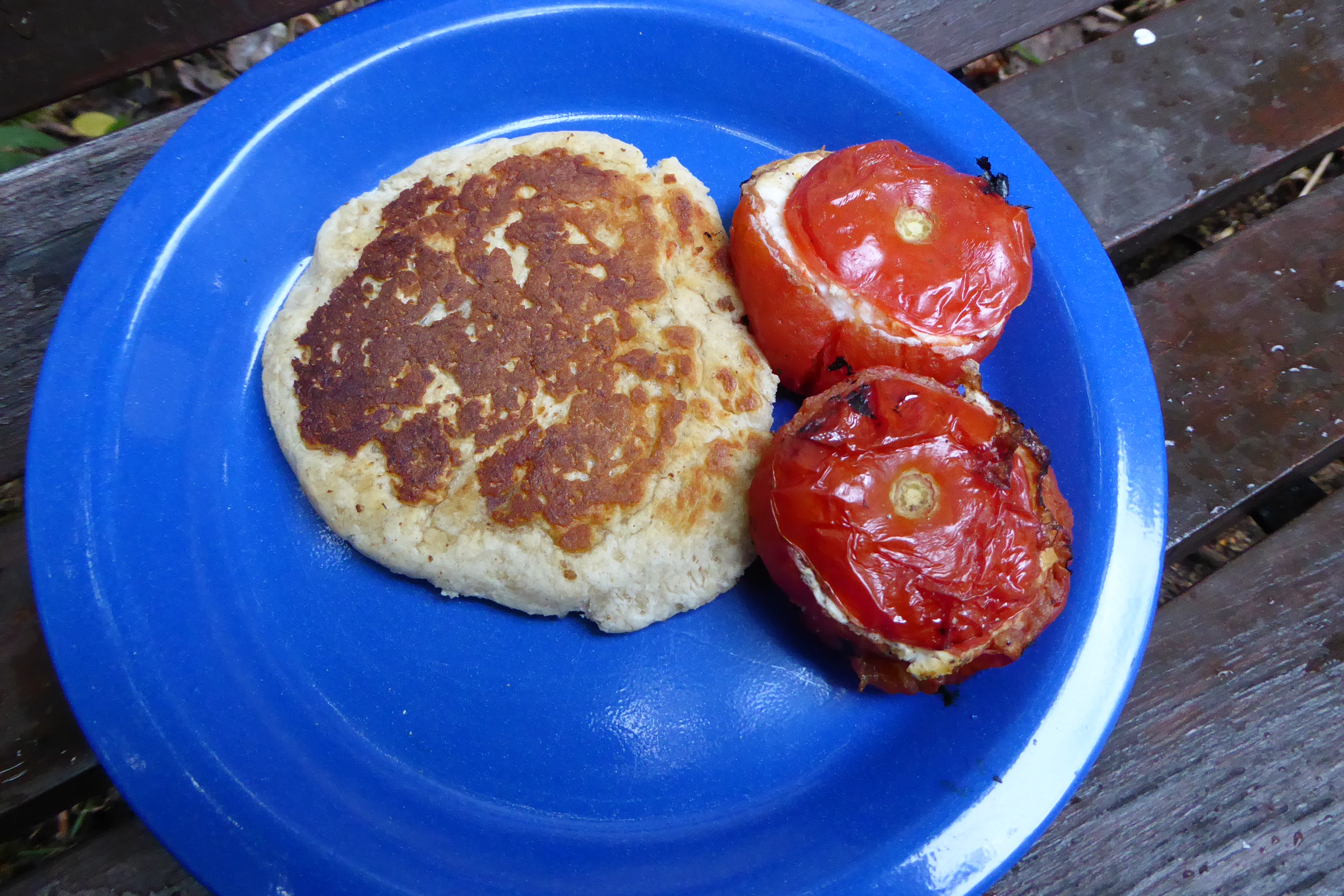
A few people have asked about the food I have cooked and how it’s made. I’m no chef but am learning and getting a bit better at it. Camping over a fire in a woodland setting is not easy. You don’t have the luxury of fingertip control over your stove or cooker, nor do you have many pieces of equipment or running water. So I have chosen to practice a few simple, easy to make meals. This dish is bannock bread and eggs in tomatoes.

Bannock is a popular food with bushcrafters and wild campers because it doesn’t need an oven, it just needs a fire and either a cast iron skillet or a stick. I guess you would describe it as an unleavened bread i.e. no yeast. To make a portion this size (enough for one) you need:

1 cup plain flour

1/4 cup dried milk powder

teaspoon of baking powder and a pinch of salt

About 1/4 cup of water

I mix the dry contents at home and put it into a medium sized ziplock bag roughly 20×20 cm. It needs to be big enough to allow you to squidge it around (knead in chef-talk). It’s convenient this way as you don’t get the sticky stuff all over your hands. When ready to make it into dough, add small amounts of water (less then you think and a bit at a time). Lock the bag again and keeping it all toward the bottom corner, start kneading it in the bag thoroughly. Open the bag now and then and check it and add a little more water until you have a stiff sticky dough. If it’s runny at all there’s too much water!

Your fire needs to consist of hot embers not flames. Camp fire management is all important when cooking. If using a skillet (my preference) add a little oil and put it over the fire. I use an old mesh baking tray as a shelf. I cut the corner off the bag and squeeze the dough out into the pan, then flatten it into a burger shape. Cook slowly for about 5-10 minutes then turn it over and repeat. You could shape the dough into a sausage and wrap it around a clean stick and prop it next to the fire turning occassionally.

The bread is quite tough and rubbery to be honest but it’s filling and easy to make. You can add dried fruit to the dry mix for a sweet version which is nice with a bit of jam or marmalade on top.

Eggs in tomatoes requires large beefsteak tomatoes, eggs and cooking foil. Slice the top off carefully and keep it, scoop out the core and seeds from the main body and discard those. Be careful not to pierce the sides, so I use a teaspoon rather than a knife. Put the tomato on a piece of cooking foil which needs to be big enough to wrap around the whole tomato, sealing it completely with a bit to spare. Carefully crack an egg into the tomato, add a pinch of salt and pepper then pop the lid back on. Don’t worry if a bit of the egg white oozes out. Wrap the foil around it and pinch the top of it together to seal it and also provide a handle to lift it with. Your fire needs to have plenty of hot embers. Place the eggs in the embers and heap some of them around and over the foil package. They need about 15 minutes and you should turn them every few minutes for even cooking. Now here’s where the little handle really comes in. Lift them out and away from your other food, blow the ashes off before opening them. The skins might have stuck to the foil a bit but you can eat them out of the foil or use a spoon to get them out and onto a plate. Easy and delicious. Enjoy.


4 Comments

Solo camping with some rain.

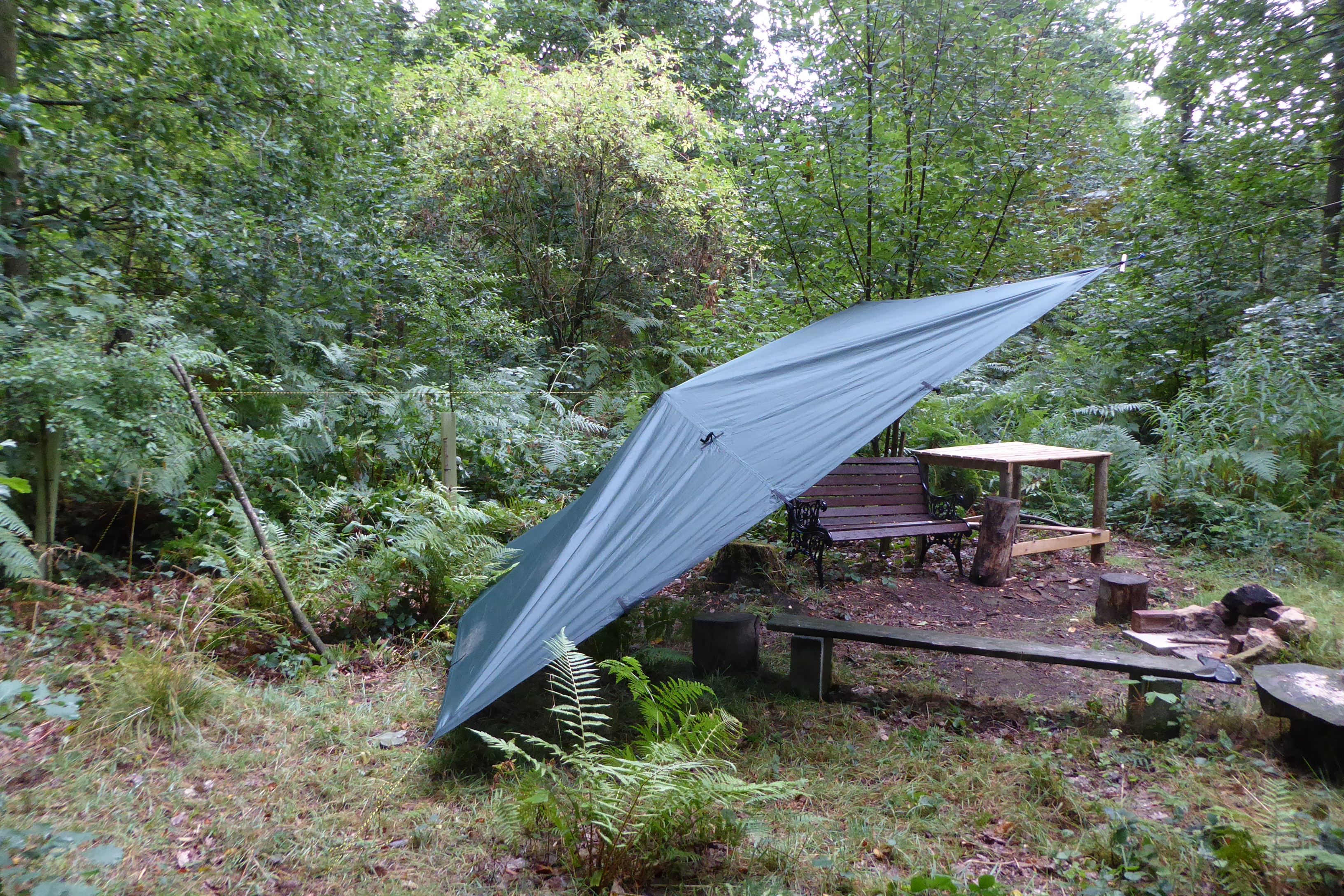
I haven’t done a solo camp this year and the summer is rapidly disappearing. The forecast wasn’t too bad for thursday/friday so I made the decision to go. When I do a camping trip, I like to try some new things and repeat some old things. That way you add something to your skills repertoire, discover how you can improve it or discard it and reinforce what you have already learnt. Last year I got caught out with some unexpected rain in the evening. I realised there was a weakness in my camping area – no shelter.  I had my tent of course but I wanted to be able to continue sitting out during the evening in front of a fire so I was keen to find a solution using my 3×3 metre tarp. There are no obvious large trees nearby to string a guy line up, so it could be a real challenge. There are many ways to configure a tarp, some very complex and not needing much support but they tend to create smaller shelters. Ideally I wanted to use the full nine metre square area, keeping it close to the fire and if possible giving some shelter over my table so that I had something to work on when preparing meals. I found the ideal set-up.
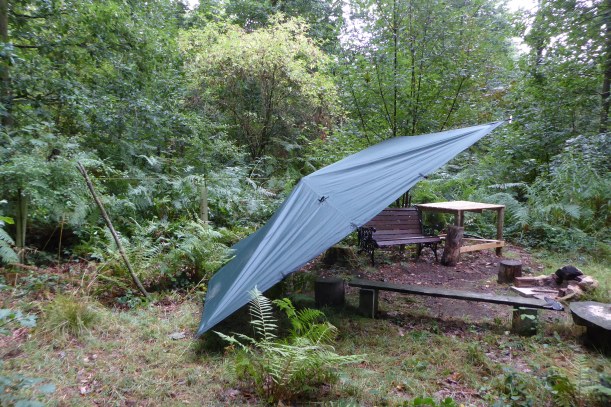
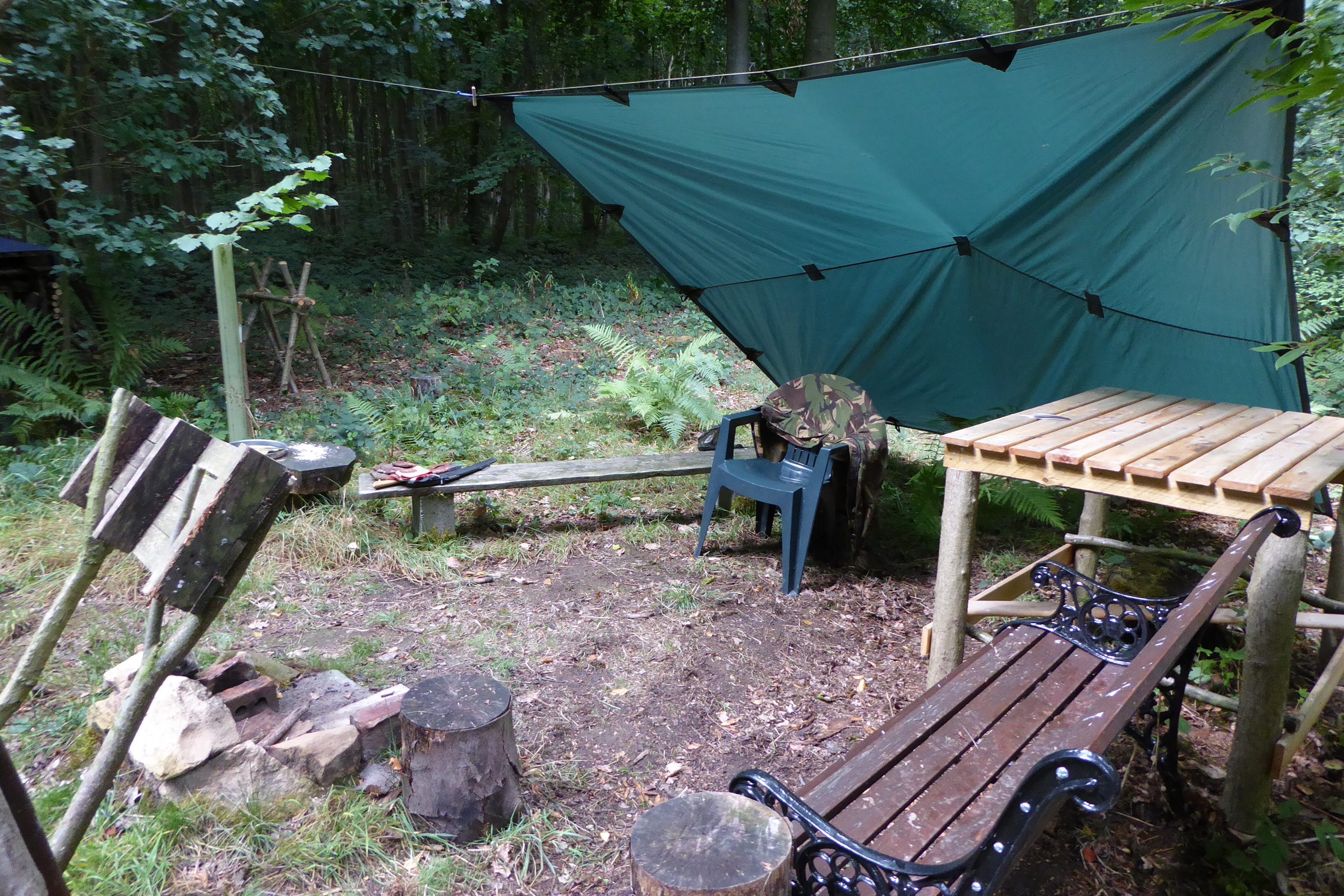
Behind the bench is a young wild cherry tree I planted three years ago. It’s done really well and now stands about six metres high. I wasn’t sure if there was enough strength to hold the guy line taut but I could always add an anchor guyline behind it to take the flex out of it. The other end was a similar situation but the positioning was spot on for a lean-to arrangement which you can see from the side. Moving the table to the left of the bench would put at least half of it under cover and there would be room for a chair. First aim ticked off.

The forecast was fine until 6 pm just about when I would be cooking. The key to a successful experience is in trying to foresee the problems and making arrangements to combat them. “Failing to plan means planning to fail”. I hadn’t tried keeping a good fire going in heavy rain so that was aim number two. I had read that if you build a good strong fire, the heat will drive off the water but for how long? Rain was only expected for an hour but that might ruin my fire and my evening meal. I built a sort of rain cover, using half a wooden pallet and some Y shaped branches. Looks very Heath Robinson but it should deflect some of the rain. Here’s how the new camp area was looking. I was pleased with it. Aim two ticked off.
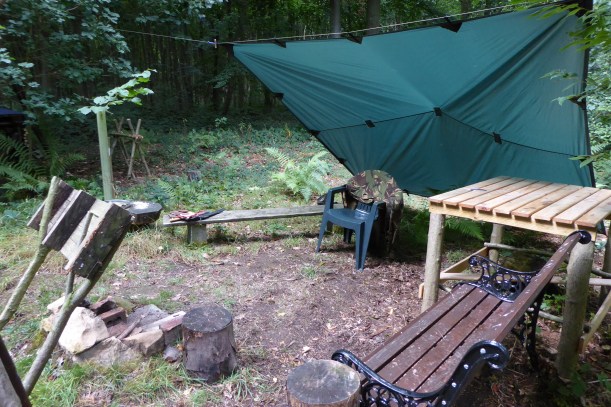
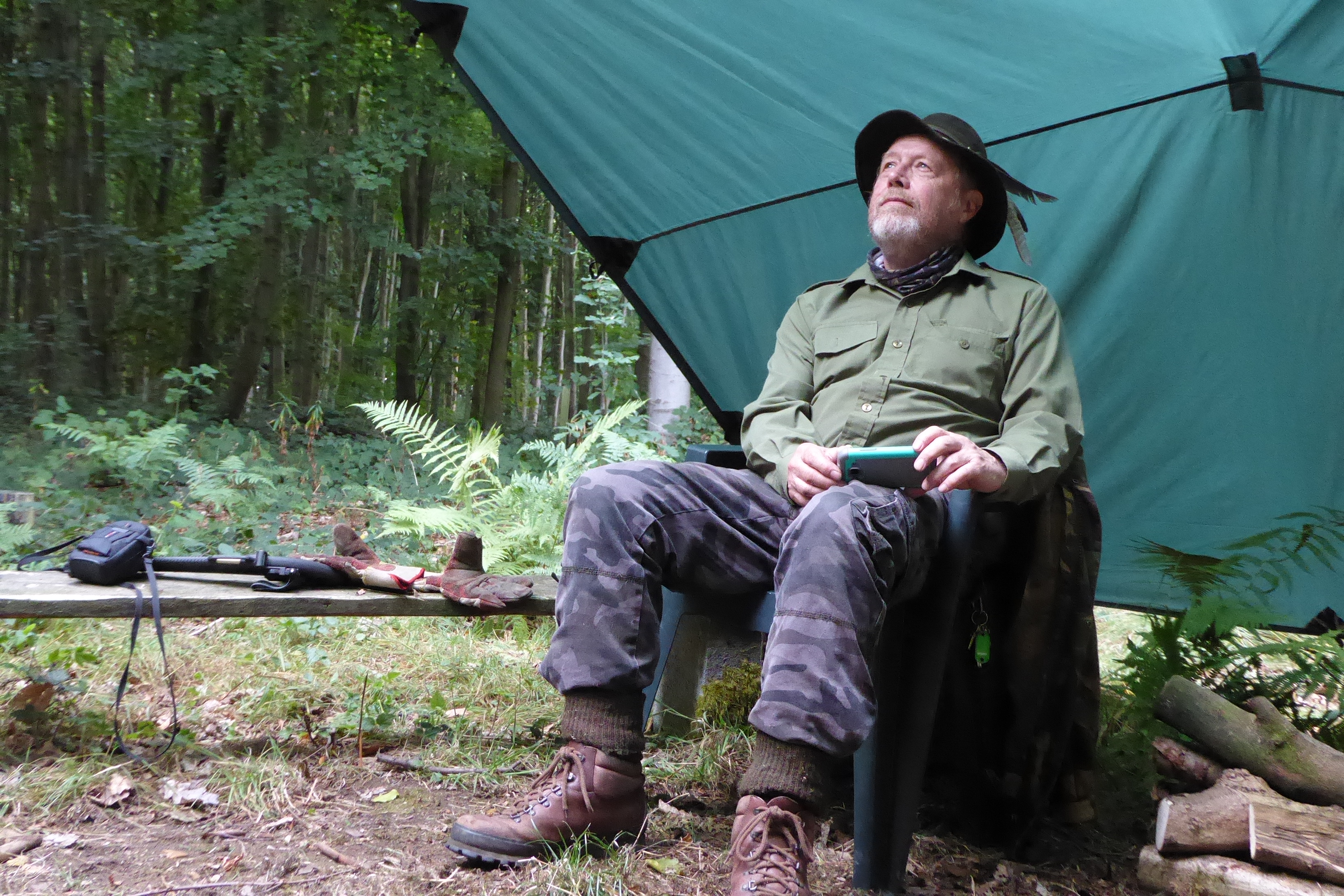
As you can see, I’m settled in and watching for that rain! Oh and if you’re thinking “He can’t keep off that smart phone though”, well I’m using an app that connects to my camera via wifi to control it remotely to take the photo. Brilliant.
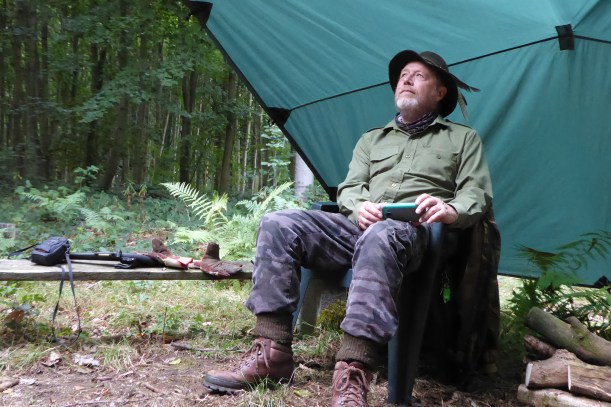
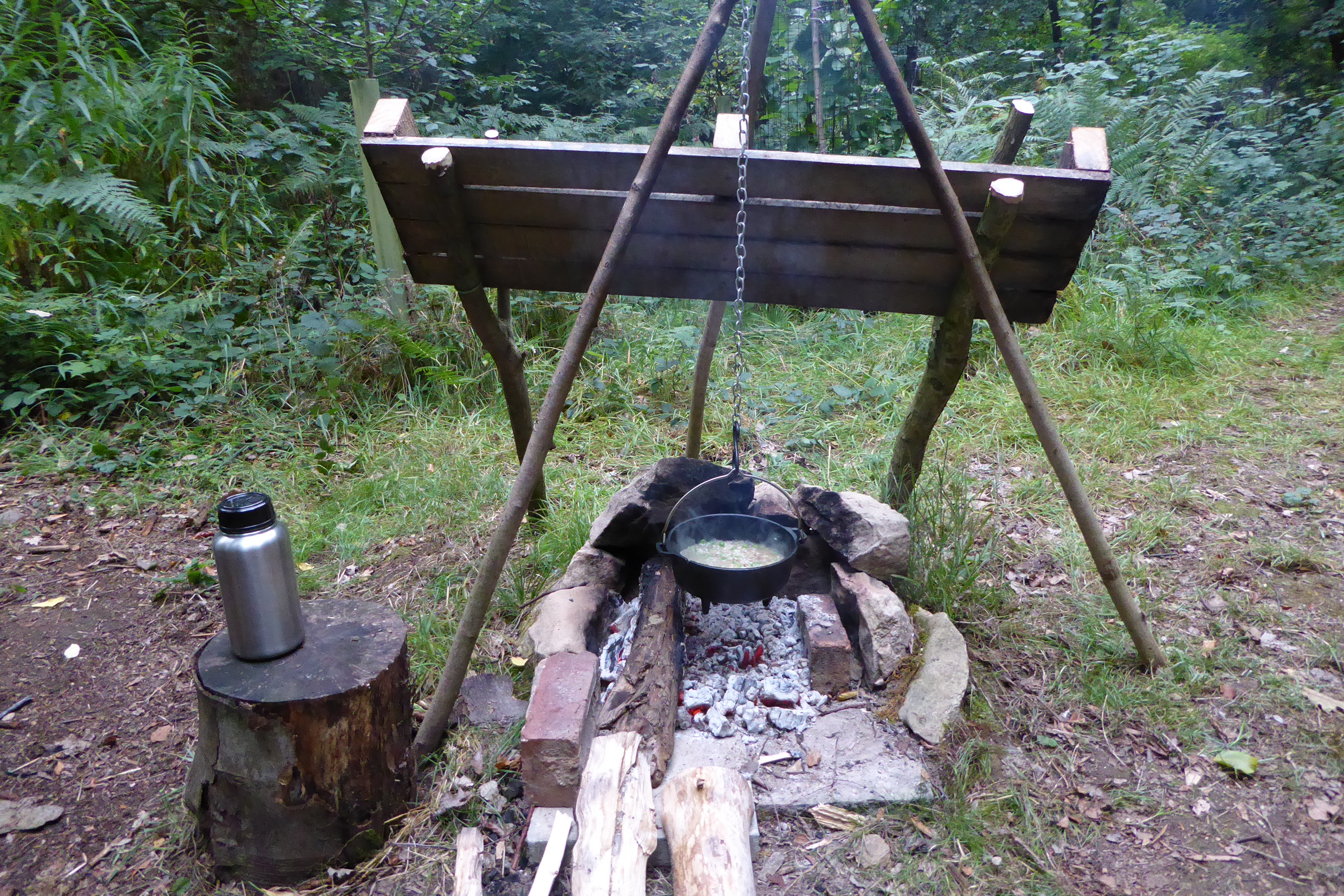
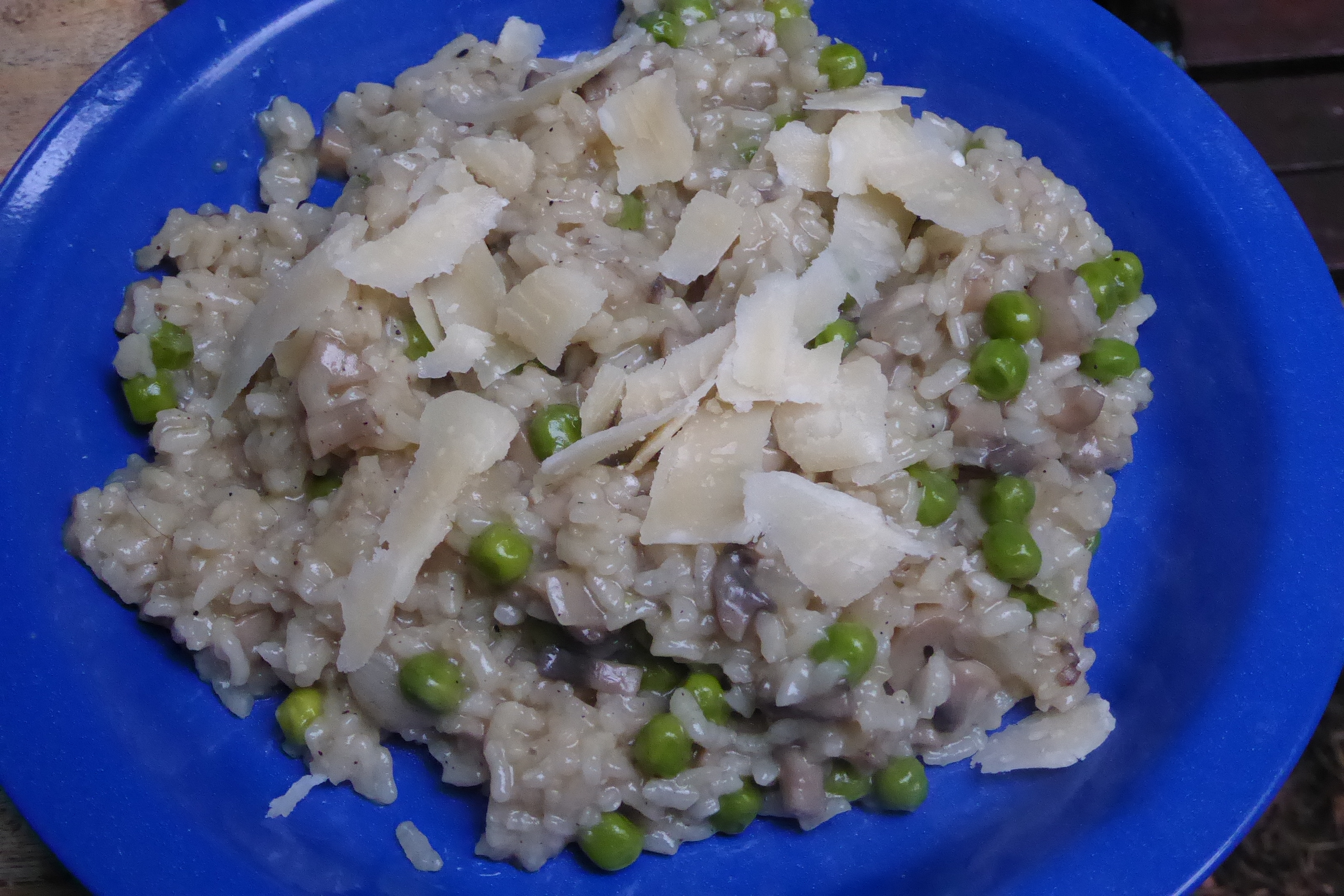
My meal was to be a veggie risotto – onion, mushrooms and peas. Not exactly exciting but as you might know, I’m not a good chef but I reckoned that would be easy and tasty, all done in my cast iron Dutch Oven pot. Got the fire going, plenty of hot embers and “the job’s a good ‘un” as we say in Yorkshire.
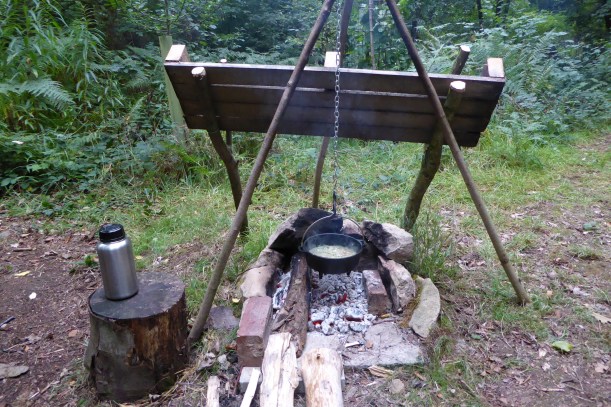
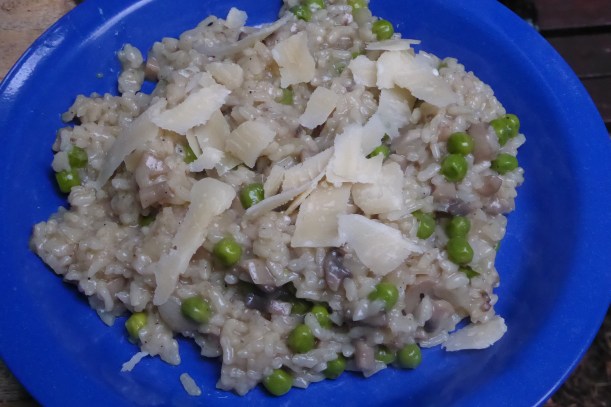
The rain held off while I cooked and ate then an hour late, it arrived. It teemed down. It ran straight off my tarp, made the fire steam and sizzle but I sat peacefully and contentedly watching it and knowing my resourceful preparations had succeeded.

The weather cleared up, I had a walk around the tracks and watched darkness close in on me, comforted by a glowing fire and a bottle of red and occasionally wondering “Why the heck I’m doing this”. The thought was only fleeting and if you are wondering the same, then trying to explain would be a waste of words. If you you haven’t wondered then you need no explanation. Hinted keywords – being alive, unique, because I can, amazing, stepping out of comfort zones, connectedness. I retired to my small tent around 11 pm and slumber came easy – no bad dreams this time.

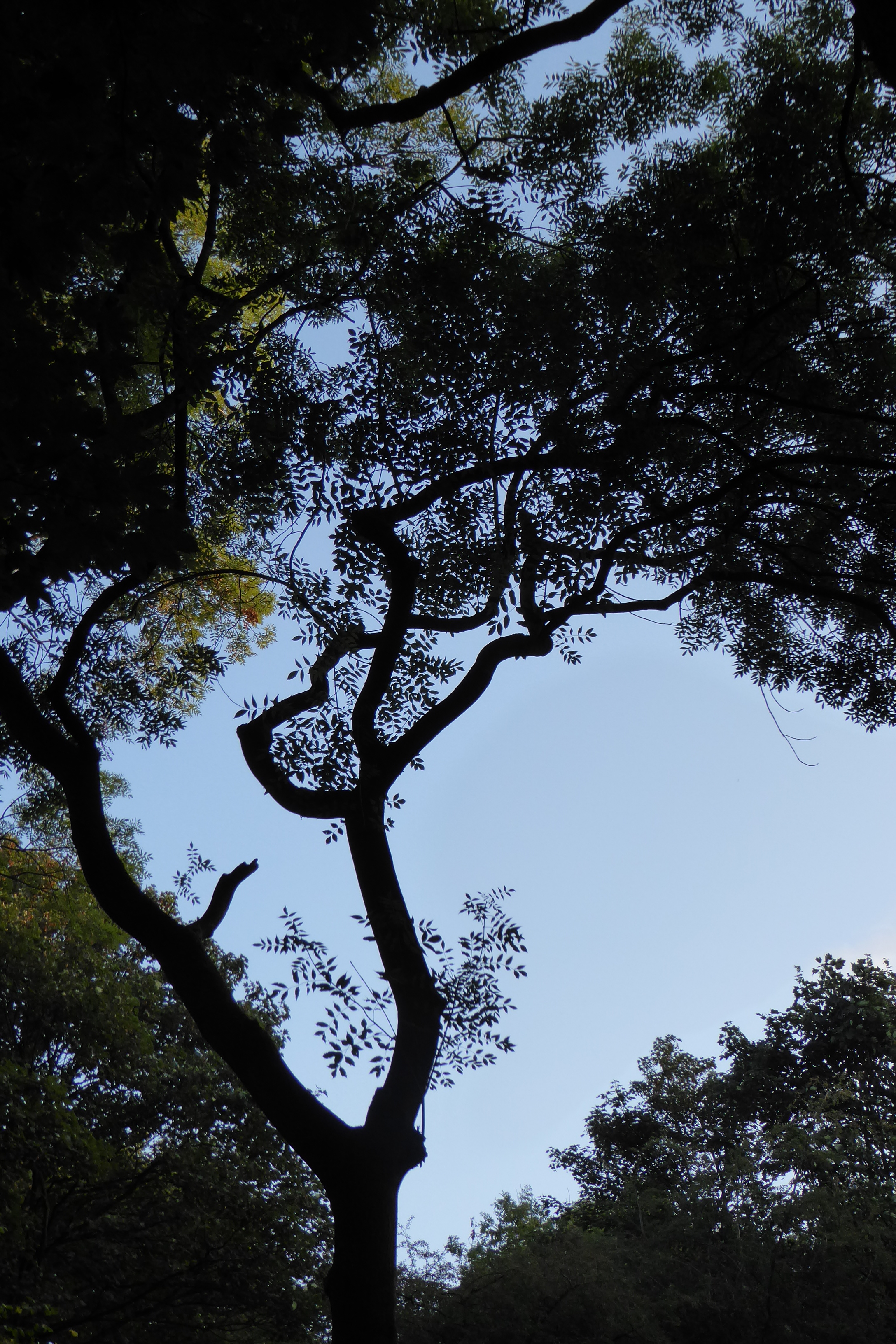
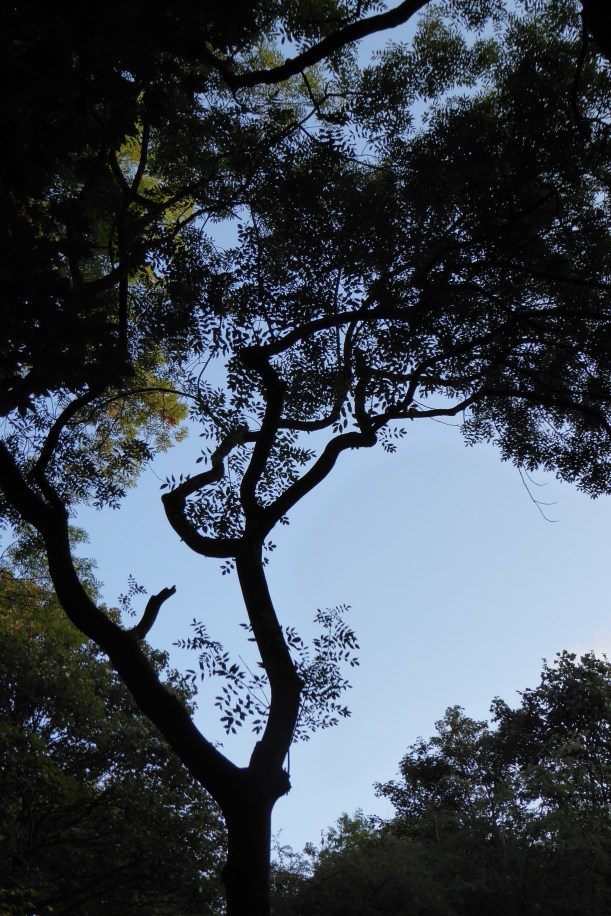
A few hours later I came to. In the distance I heard a terrifying screech. Again but closer and followed by a another blood curdling sound. Lying in the middle of a dark woods, on your own with only two thin layers of nylon as cover gets your heart racing immediately. The two sounds were closing in on me, closer and louder. Logical brain took over from neanderthal, fight or flight brain –  it was tawny owls. Now most folk think that all owls go “toowit towoo” in a  lovely calming and benign manner – wrong. The calls can be loud and aggressive. Maybe there was a territorial battle or a bit of owlish matrimonial disagreement. The toowit is the female and the toowoo is the male tawny owl. But the toowit is more like a demented “creeeech” sound and the towoo (though not demented) more like an elongated “wuwuwuwuwoo”. I relaxed and listened as they zoomed past, like low flying fighter planes, disapperaing deep into the woods and gone again. Silence resumed. I slept quite well but early daylight and the incessant call of a wood pigeon and “twit twit” of a nearby wren signalled time to get up. It was 6.00am. Another walkabout down the rides but no wildlfife to be seen. I was hoping the spot some roe deer. This lovely silhouette of an ash tree was at the bottom of my woods.
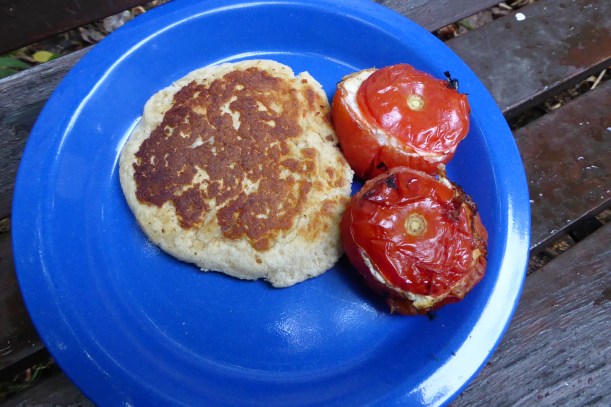
Fire re-lit and breakfast of eggs-in-tomatoes, bannock bread and filter coffee. Fit for a king – or at least me! Just short of some baked beans – note to myself!
Rain was forecast again around midday so morning was mainly spent packing and dismantling camp. I’d planned to cook some lunch but it was looking like too much trouble in the rain with the shelter down now. It started early so I headed to my permanent shelter to sit and watch. I’d done some more work on the renovation and half of the sides are now in place. It was nice and dry.
The rain increased intensity. I thought I heard an airplane taking off – a deep roar getting closer. CRACK. I never saw the lightning, just a long and very loud, elongated explosion of sound moving right over me, left to right in fantastic, thundery, surround sound. It felt quite primeval in the middle of a forest. I was tired and satisfied, time to call it a day. As it eased off I headed home, another fantastic woodland experience to remember.



Leave a comment

Weekend camp with some mates part three – the morning after and a surprise visit

I probably had about three hours sleep in total waking around 6am with a banging headache. Rain was gently pattering on my roof as it fell lazily from the overhead leaves. What a beautiful place to start the day.  I dressed and emerged and pulled the car forward out of the tarp I had erected to act as a porch, re-pegging it to form a nice shelter big enough for four people to sit under. Kettle on. My two mates were still in their woodland bedrooms so I just sat with a strong coffee and watched and listened to the birds singing and bobbing around. Phil was next up and had been visited by a robin. He described how it had tried to land on his feet then settled on the ground in front of his face. It’s coal black eyes looking directly into his. This close connection with a wild creature, no matter how small is awesome. But that was dwarfed by Alan’s.
In part one I promised you a surprise the following morning. Alan called around. He awoke in his cabin to hear a slurping sound right outside. He quietly peered through the window to see the magnifient six-point antlered, buck roe deer, drinking rain water from a bowl he had left outside, literally a few feet away. He watched frightened to move and disturb it. Eventually it departed but was spotted again by his car. As he walked down the track to visit us it followed him for a while. These are the special treats you are sometimes rewarded with when you step outside the compartment of everyday urbanity and into the wild.
Finally Simon emerged and enthused at how he was able to open his tent door and rather than be confronted by a campsite full of families and noisy kids, was able to lay there with a living woodland window of trees, plants and birds. We spent the rest of the morning sitting, chatting and recounting our weekend. A lazy brunch of fried egg sarnies (sandwiches to those unfamiliar with the word) and plentiful coffee. We packed our gear, and in the Native Indian and bushcaft ethos, tidied up “leaving no trace but footprints and memories”. The memories will live on for a long time. Fantastic weekend and mini adventure, thanks guys for making it so.


Leave a comment

Weekend camp with some mates part two – cooking, bat watching and story telling

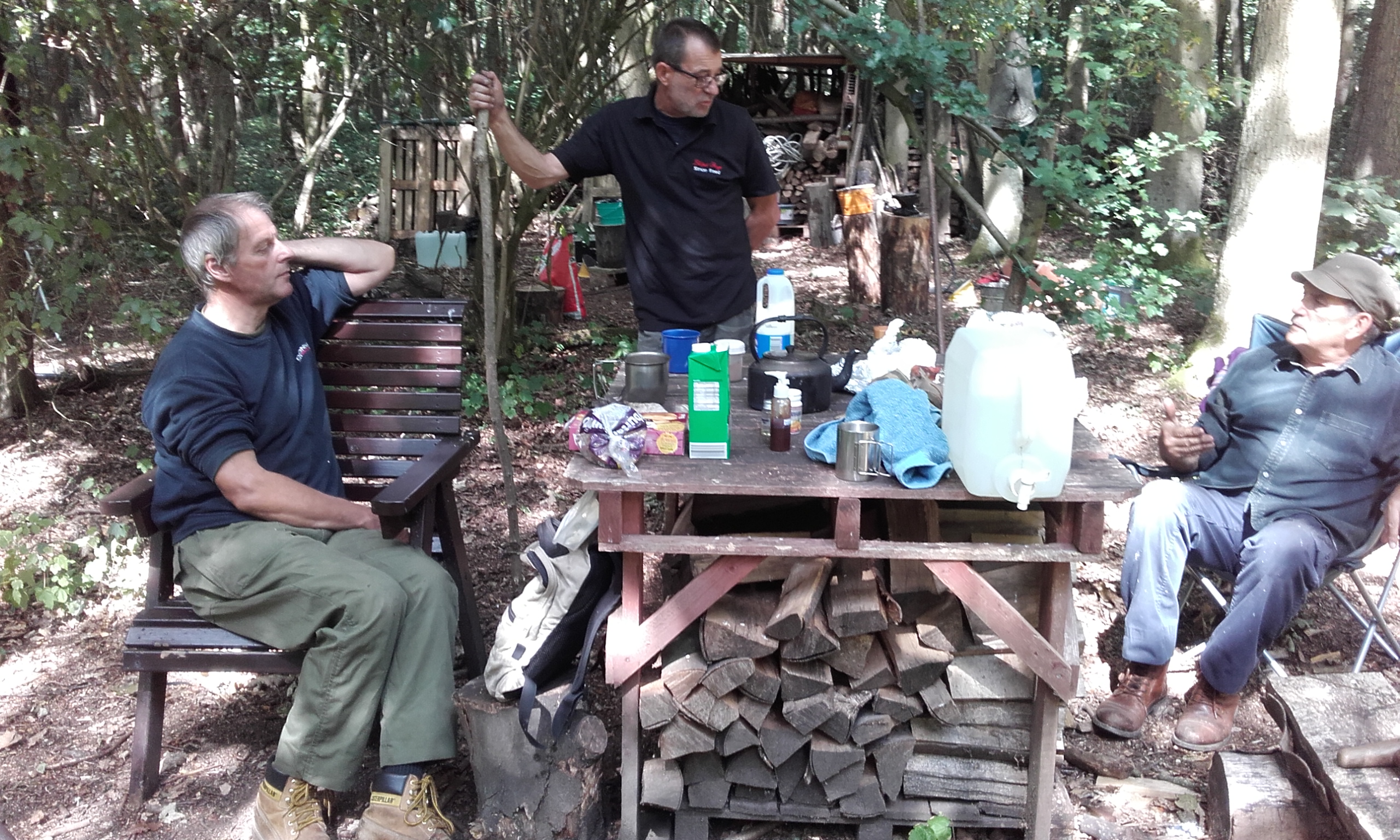
After a hectic day, it was time for some food and relaxation. We all have different dietary requirements so I had planned to take cooked potatoes and onions to fry up and frozen peas for us all and suggested each should take come meat of fish to have with it. Being a non meat-eater I took a whole trout, Phil took a salmon steak, Simon took a beef steak and Alan brought a dahl curry and rice. Rain was forecast so I decided cooking over a fire might be difficult, so we opted for using portable camping stoves. We had just two small cast irons skillets and a slightly larger frying pan and only three rings to cook all this diverse food on. By admission I’m a pretty useless cook. I can do simple meals but this scenario threw me into a panic. How to juggle with preparing, cooking and serving it all at the same time seemed like a personal nightmare. Here comes Phil to the rescue. Calmly and efficiently he led the way with his expert knowledge and I want to say publicly, a big thankyou. It all came together beautifully and we enjoyed a fantastic meal, Sadly I took no more photos as I was too busy and preoccupied but here’s a shot earlier in the day with the guys taking a break in my woodland “restaurant”

Alan had told us how he gets a show of bats at dusk in his clearing. He has built a fantastic cabin with wood he has felled and planked from his own trees. The prospect of rain dictated we should go round to his place for the evening where we could listen to the bat chatter on his detector and relax with a few drinks. We were rewarded with some pipistrelles (our smallest bats). Alan showed us some video clips from his wildlife camera with foxes, owls, mice, a hedgehog, hare and some roe deer. One shot showed a magnificent male (buck) sporting a six point antler. Be sure to read part three for a special surprise next morning.

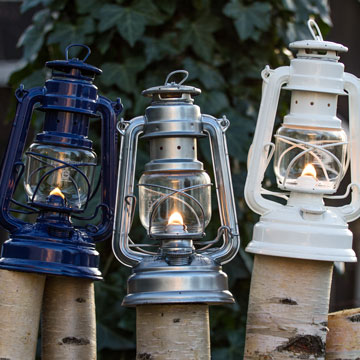
The rain came and we retreated into the hut. Lit by the warm yellow light of a couple of old fashioned paraffin storm lanterns, (mine is like the centre one – a German made Feurehand that I bought at a car boot sale for a few pounds). Add the patter of rain and it made a unique setting for story telling over a few drinks. Well we are all in the late summer or autumn of our lives, done a lot of mileage and picked up a few experiences and enjoy a good tale mixed with laughter. We had plenty to tell and laugh about and the evening rolled on till 2 am when we left Alan and headed back to my place to get some sleep. I opted for my in-car-sleep-on-a wooden-board set up (designed for quick re-deployment when it’s expected to rain). Simon was in his ex-army tent and Phil on the floor in his bivvie bag, sheltered by a tarp over him. It rained most of the night. Here’s a few photos from earlier.

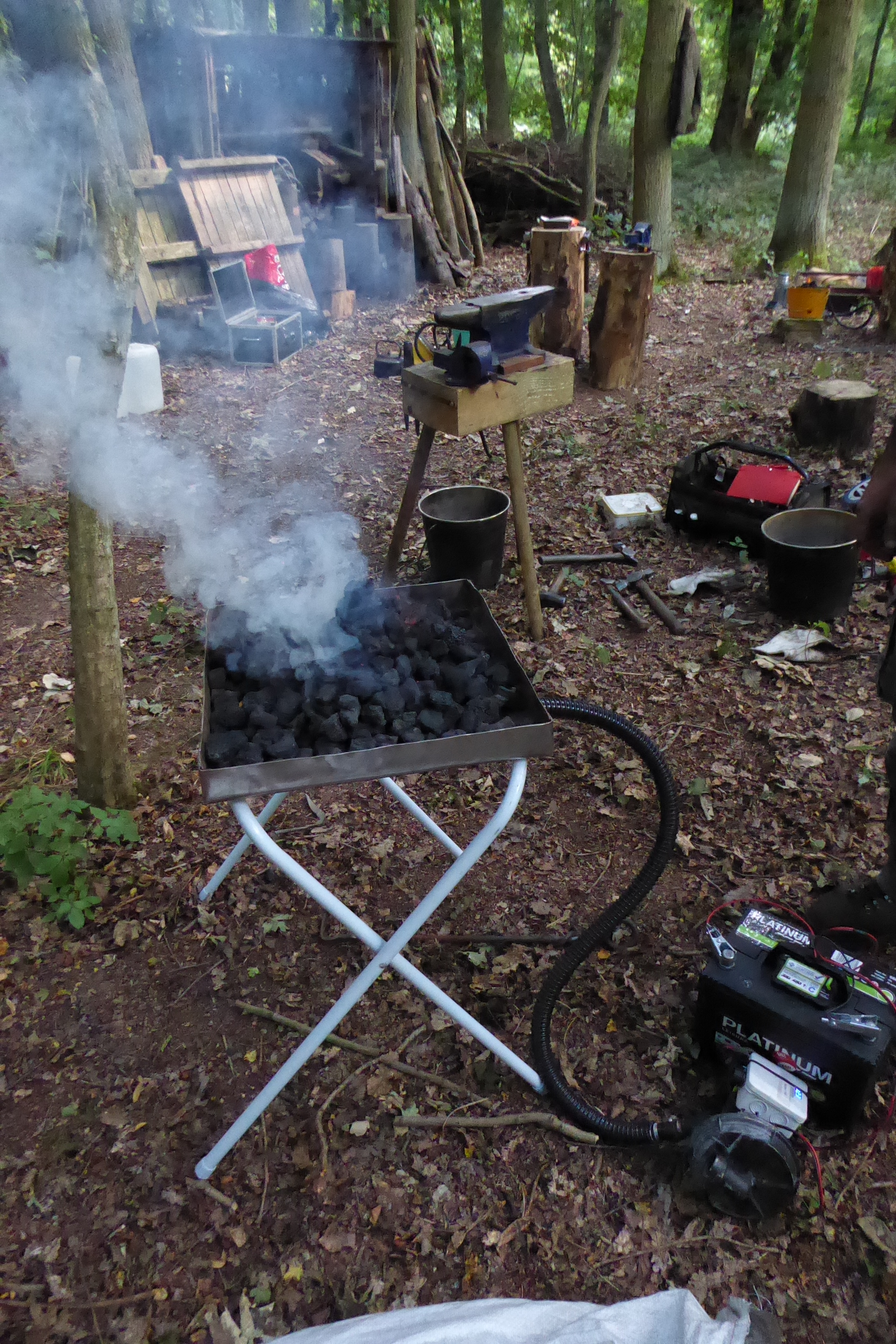
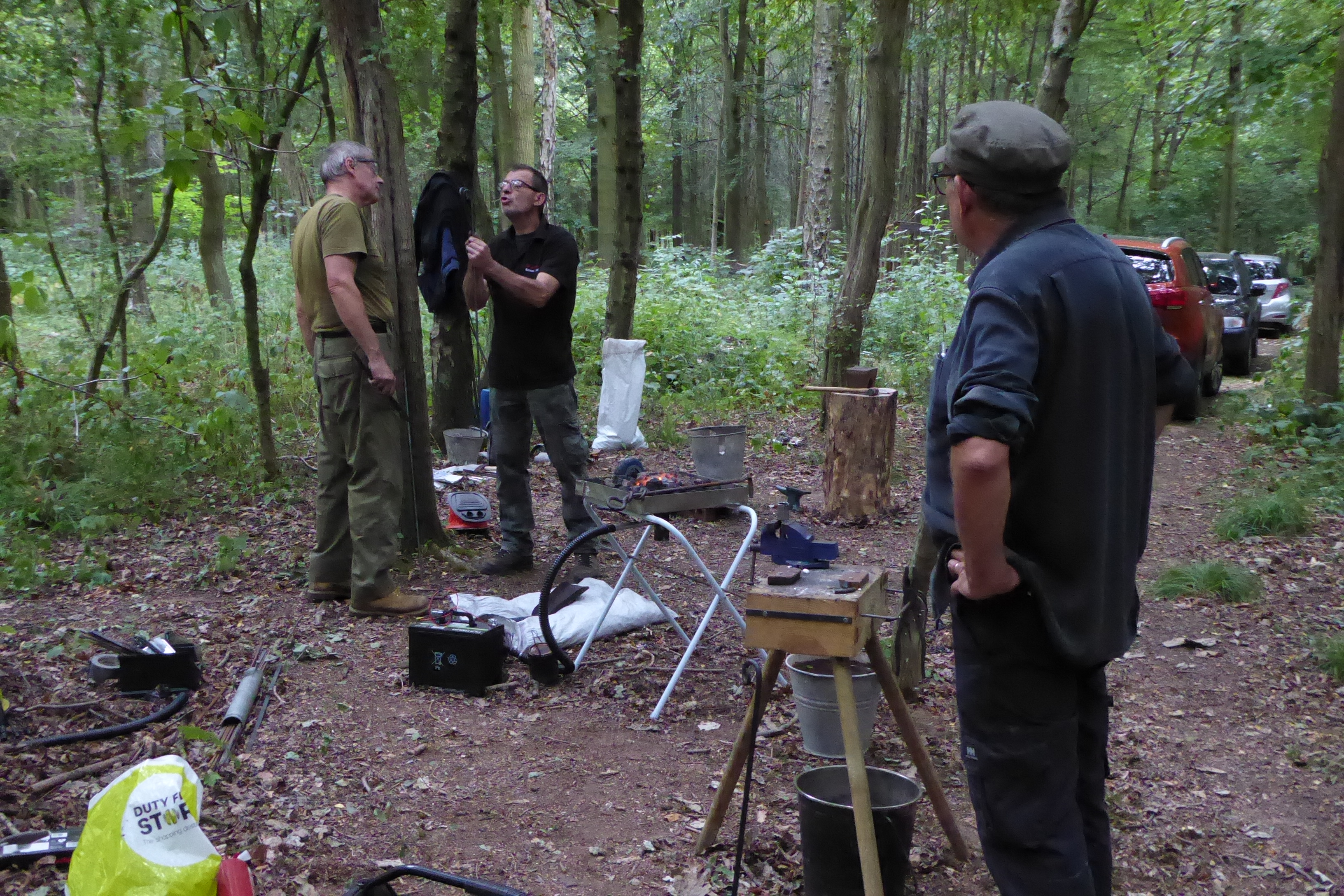
Simon’s own design of a portable forge, firing up on small coke rather than charcoal. This design allows the steeel to lay flatter and to work on longer pieces than the bucket version. The blower is powered by a leisure battery topped up with a solar panel and airflow controlled with his bit of electronic wizardry.

Alan setting up and looking the part at least


4 Comments

Weekend camp with some mates part one – blacksmithing

What a weekend! For a long time, some very good friends of mine have talked about having a blacksmithing session in my woods, combining it with an overnighter. There are my two good mates Simon (the blacksmith), Phil (trained chef and bushcrafter) and a woodland neighbour Alan (a man of too many talents to list). The weather forecast showed rain later but most of the saturday looked fine. We arrived early, parked up and got out for a chat. The woodland magic started. A tiny woodmouse appeared, apparently oblivious to us. Normally they disappear in seconds if they spot you. It went down a hole in the ground then resurfaced. It headed towards us and we stood marvelling at this beautiful tiny creature for several minutes, at one point it was centimetres away from our feet. It was to be the start of an amazing weekend.

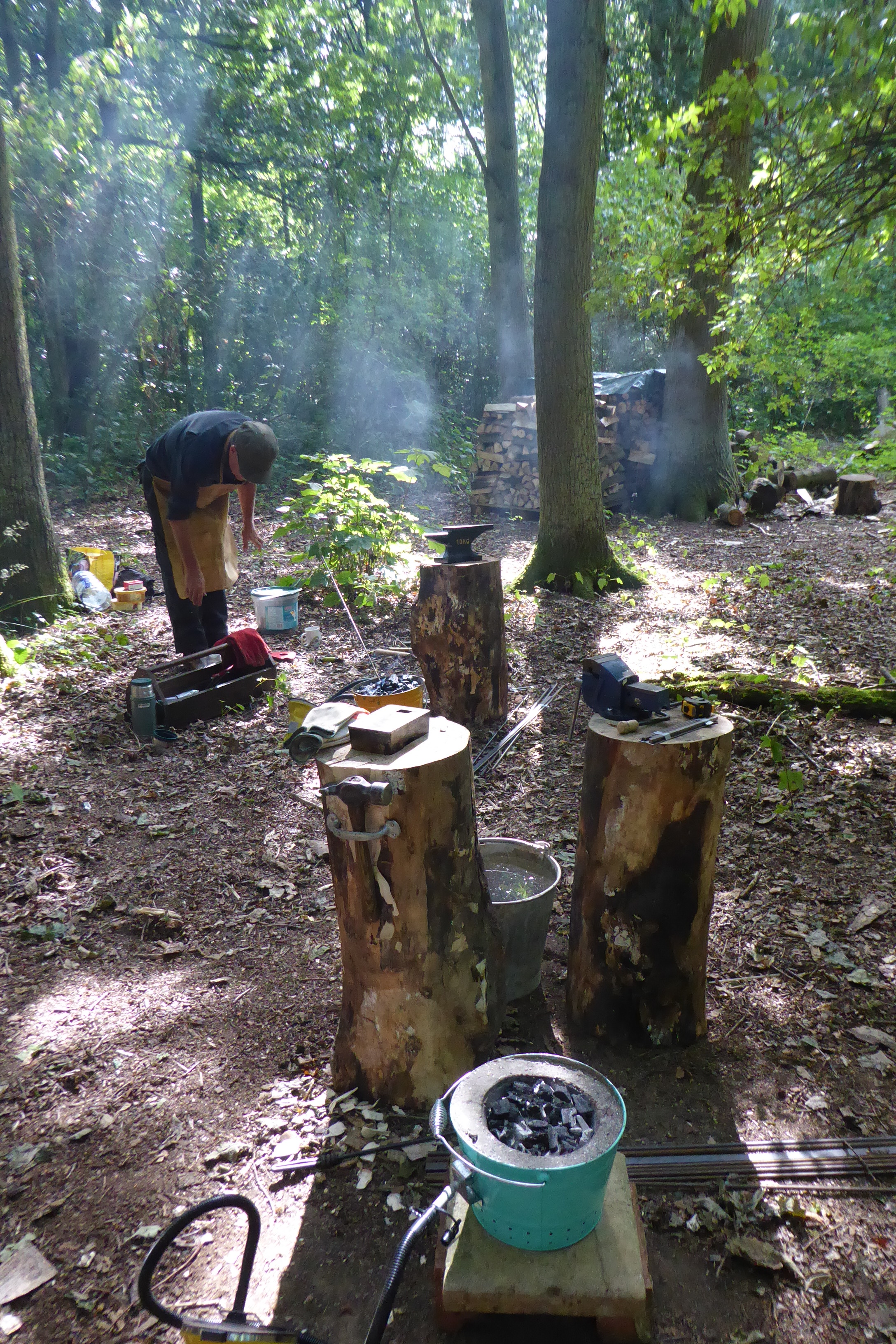
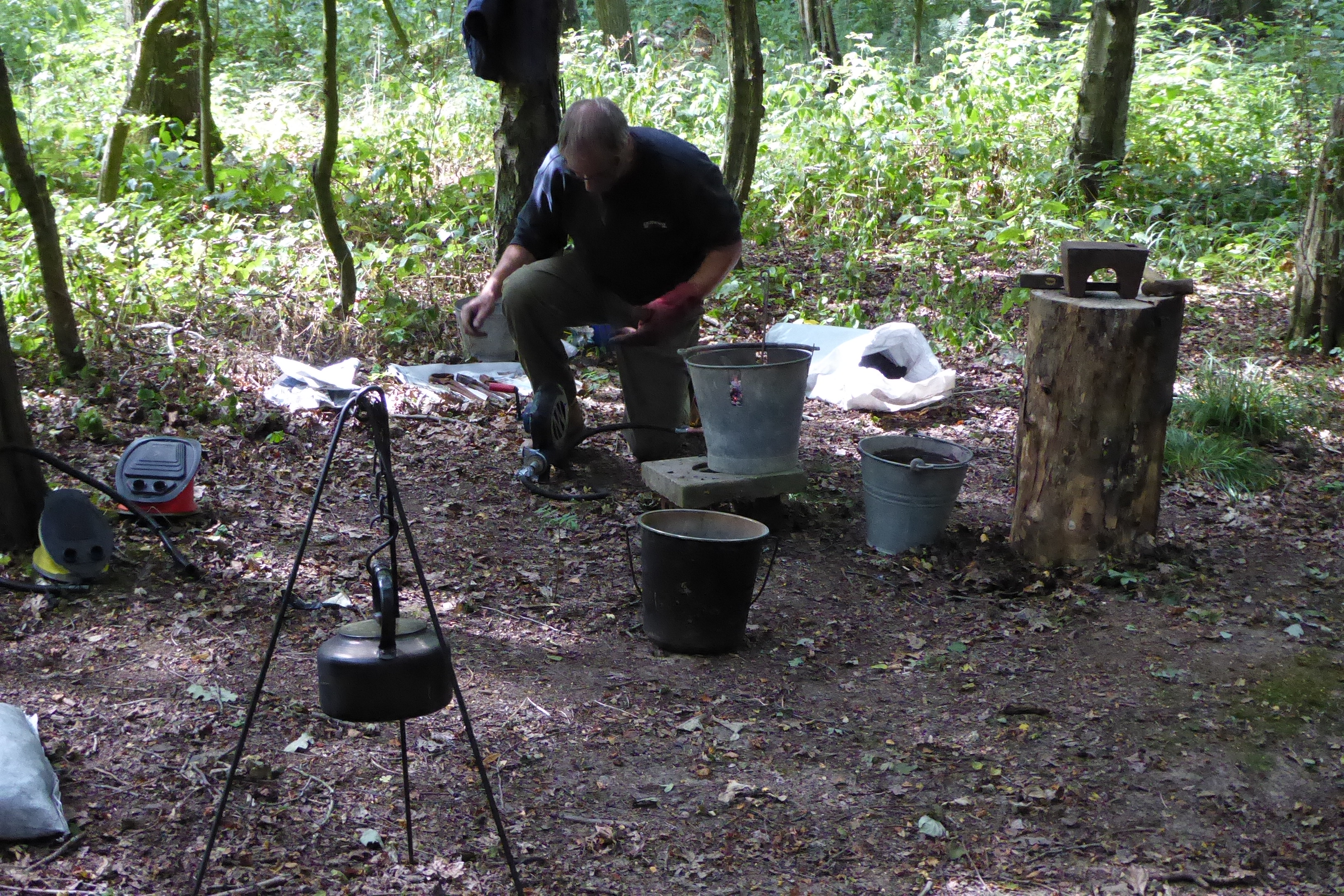
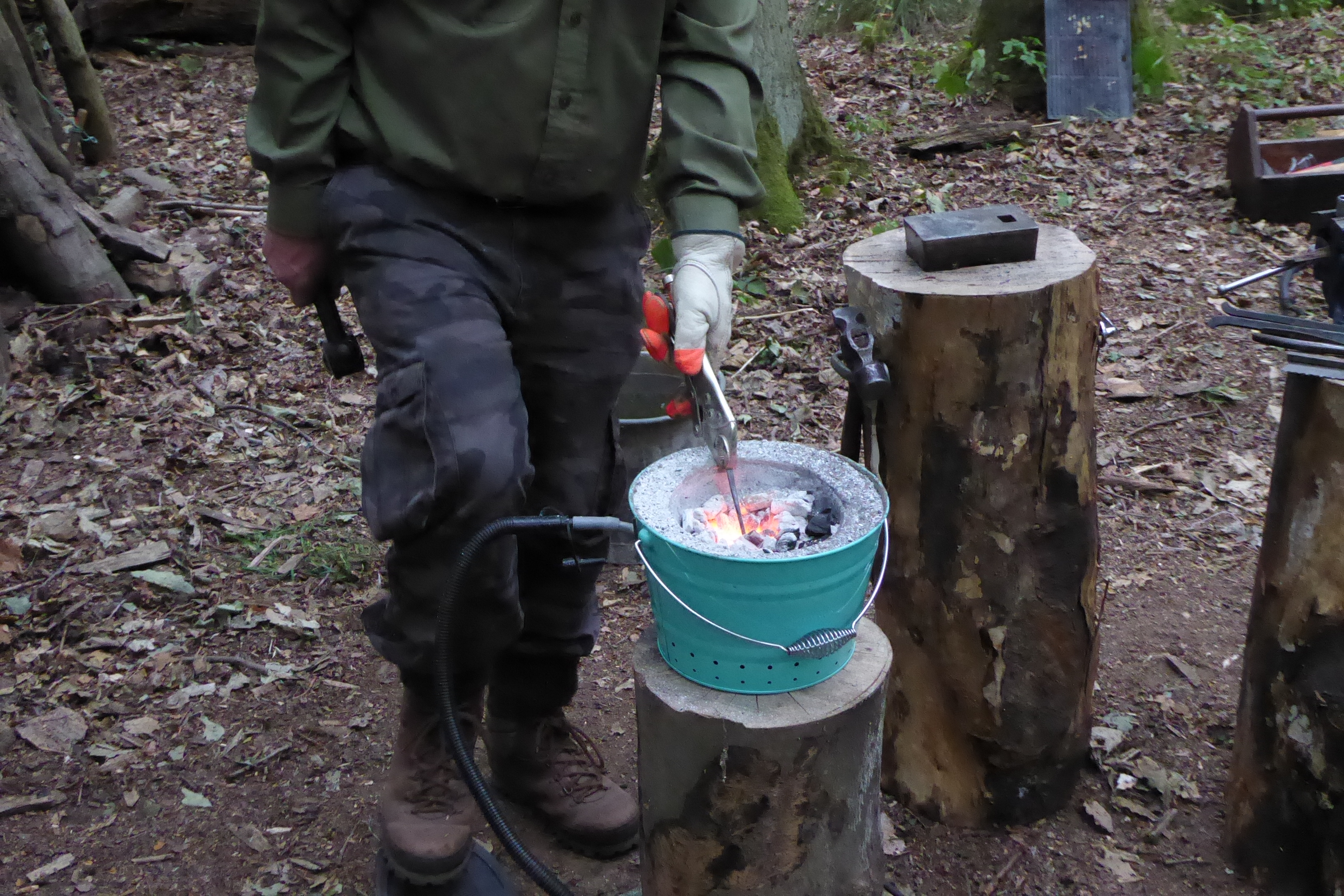
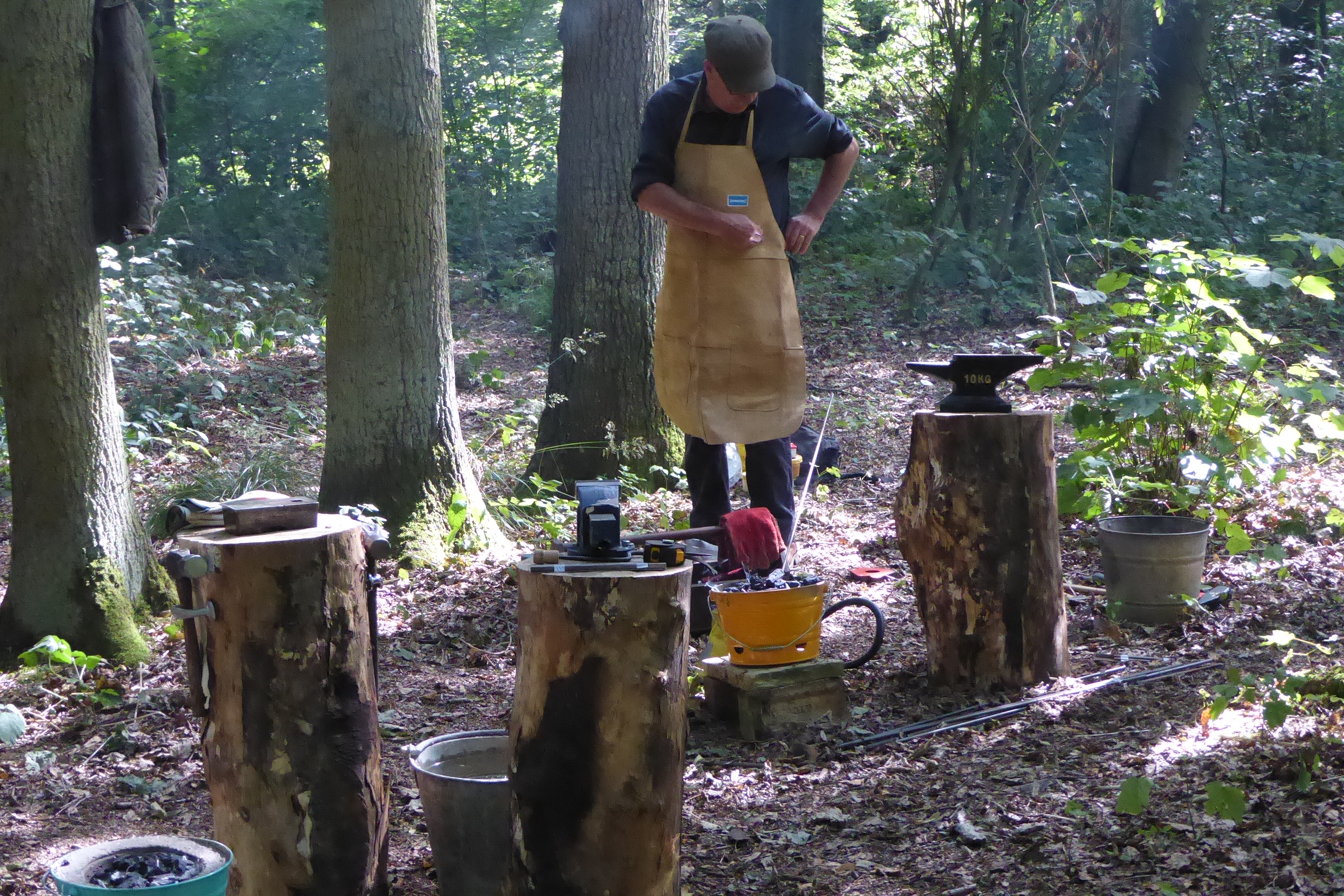
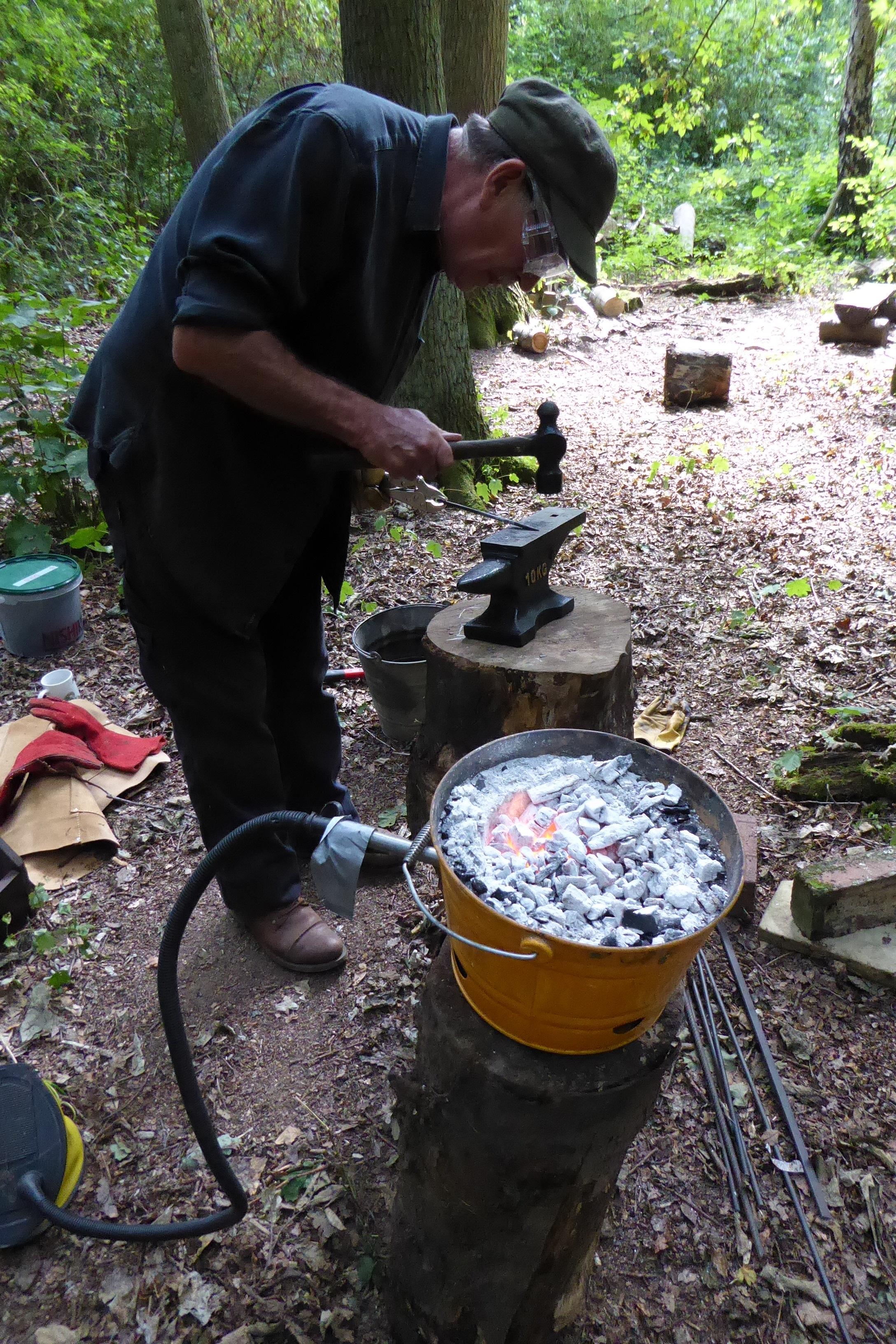
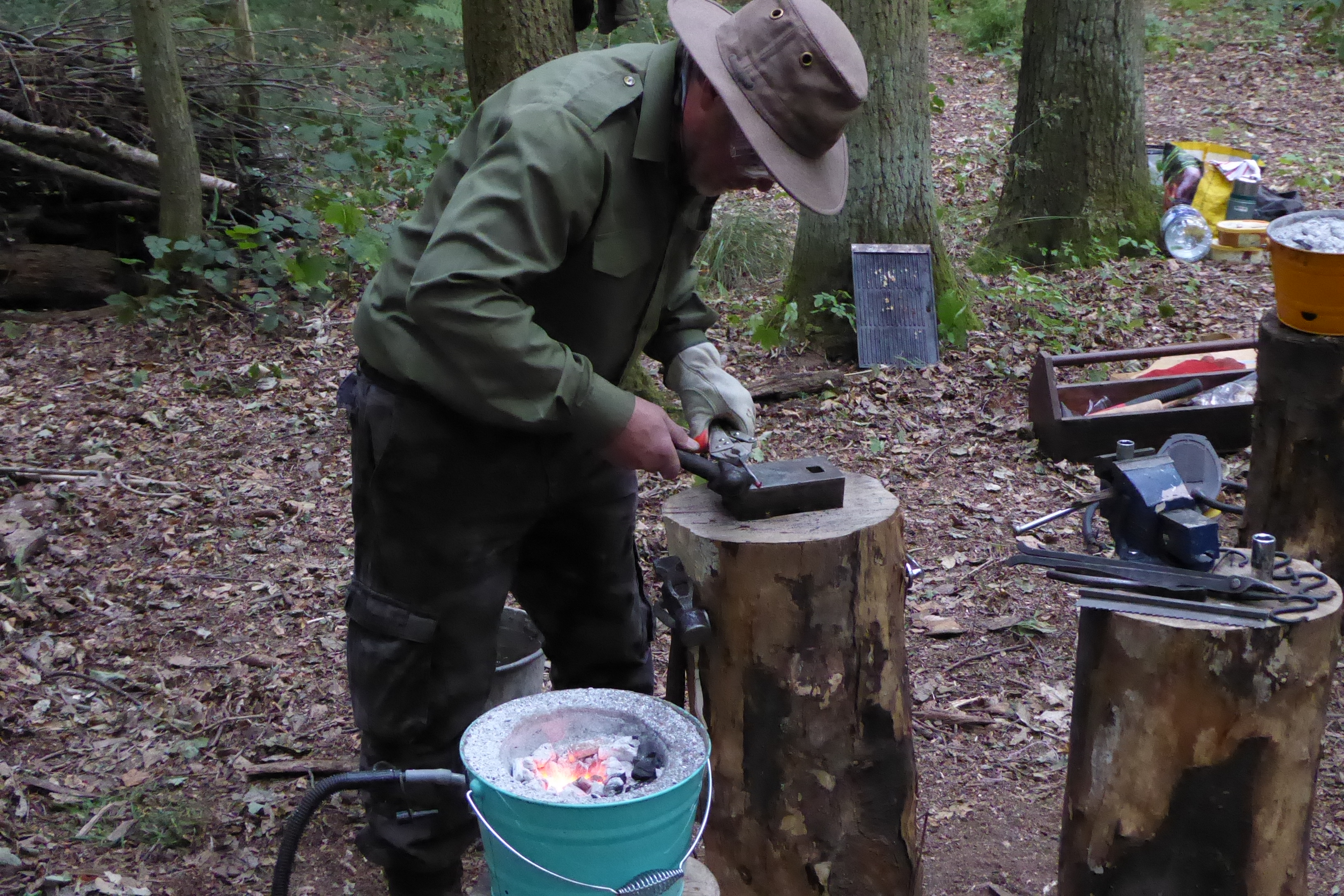
Simon runs blacksmithing experience sessions as well as producing his own work. His speciality is small and beautiful artisan products, jewelry, and useful household, garden and bushcraft oriented accessories rather than large heavy duty forge work. His business is aptly named The Lilliput Forge. The aim was to instruct us in the basics of setting up a portable charcoal forge, some basic blacksmithing skills and the opportunity to make something useful for ourselves. Something every woodland camper finds useful are S-hooks, mainly used for suspending cooking pots over fires. That was to be our first project. Although they sound like a simple product, to make a beautiful ornate one to be proud of requires numerous skills and techniques which are the basis for making many other items. First job – set up our individual work stations and light our forges. We were using homemade bucket forges and charcoal, basically a bucket (mine was a barbecue bucket) lined with fireproof cement. A hole and tube through the side allows you to connect an air pump to blow oxygen into the base of the charcoal fire, to raise the temperature enough to heat the steel you are working with.

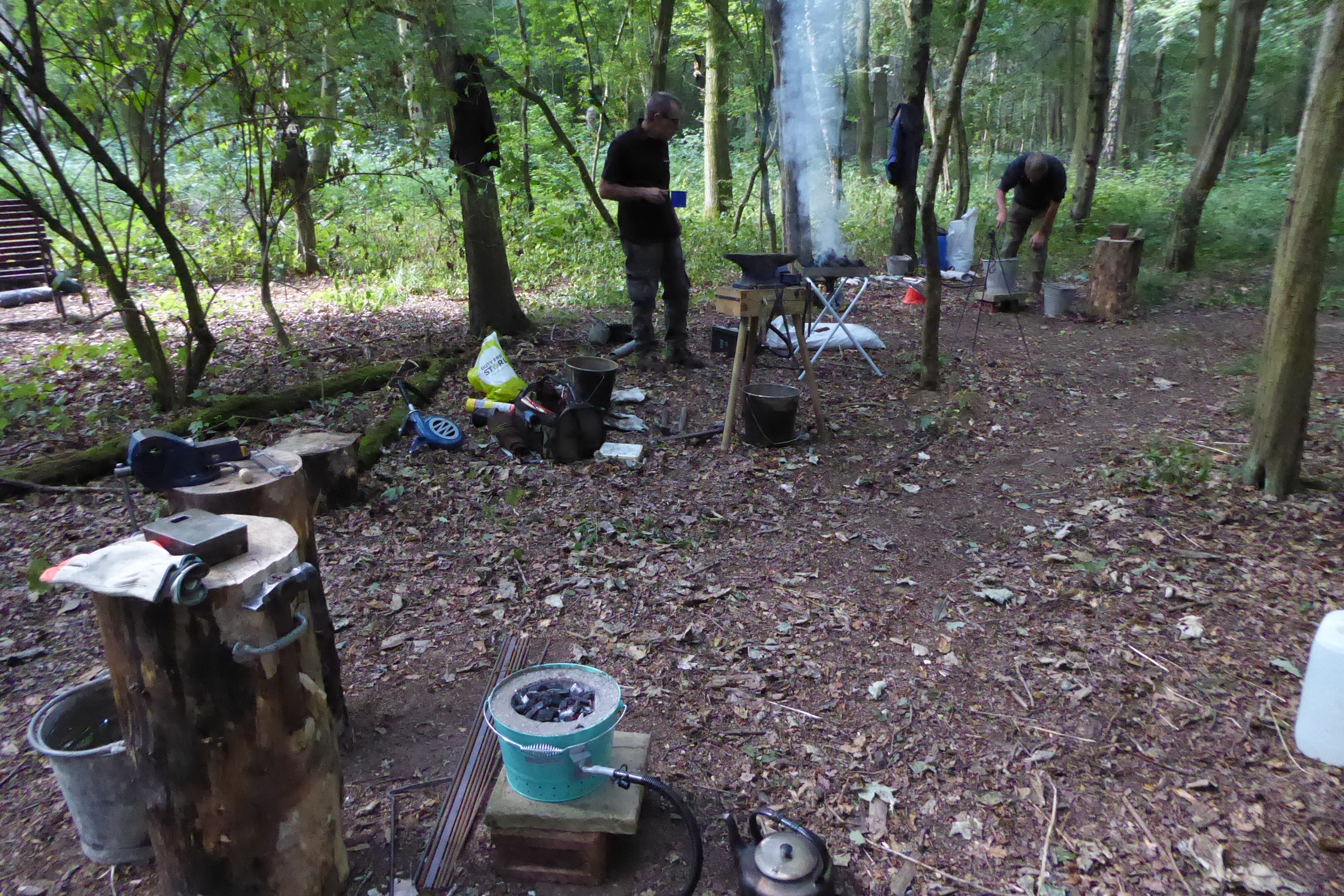
You can see my forge in the foreground – the bucket fire, stump anvil and vice I made in my last post and water bucket for quenching the hot steel; Simon centre (coffee mug in hand) and Phil (top right). Simon expertly led us through the processes of making an S-hook step by step and we each took to our stations and set about making one, sometimes gently coaxing us and sometimes admonishing us for making mistakes that showed we either hadn’t listened properly or simply forgotten his instructions. To make the hook we took a short piece of 6mm mild steel, squared and tapered the ends, rounded them off again, put a tight curl or finial on the ends, then bent them into the S shape then finishing them with beeswax and graphite paste. Easier said then done. Here’s Alan concentrating and working on his taper.

Here’s Simon explaining something to Phil while Alan looks on bemused and wondering if he’s blowing Phil a kiss!

I find blacksmithing very satisfying but at times quite stressful. It can be full-on and fast paced. I’m more at home with woodworking which I have had plenty of experience with and which allows a slower and steadier pace of working. You might have tried the old co-ordination trick of patting your head with one hand whilst stroking your stomach in a circular motion with the other – it’s difficult isn’t it? Well imagine you’re an octopus with several limbs and you have to perform numerous other tasks at the same time and all done under the pressure of remembering what to do and getting it right in the few seconds you have before the hot steel cools down to an unworkable temperature. Of course it’s like anything else, it takes hours of practice before you can do it proficiently and without thinking. Nevertheless we all managed to make something to be proud of. I’ve had a few blacksmithing sessions with Simon before but didn’t feel confident and felt like I was all “fingers and thumbs” but that certainly helped because I soon started to get into the swing of it. Here’s me working on my finial curl.

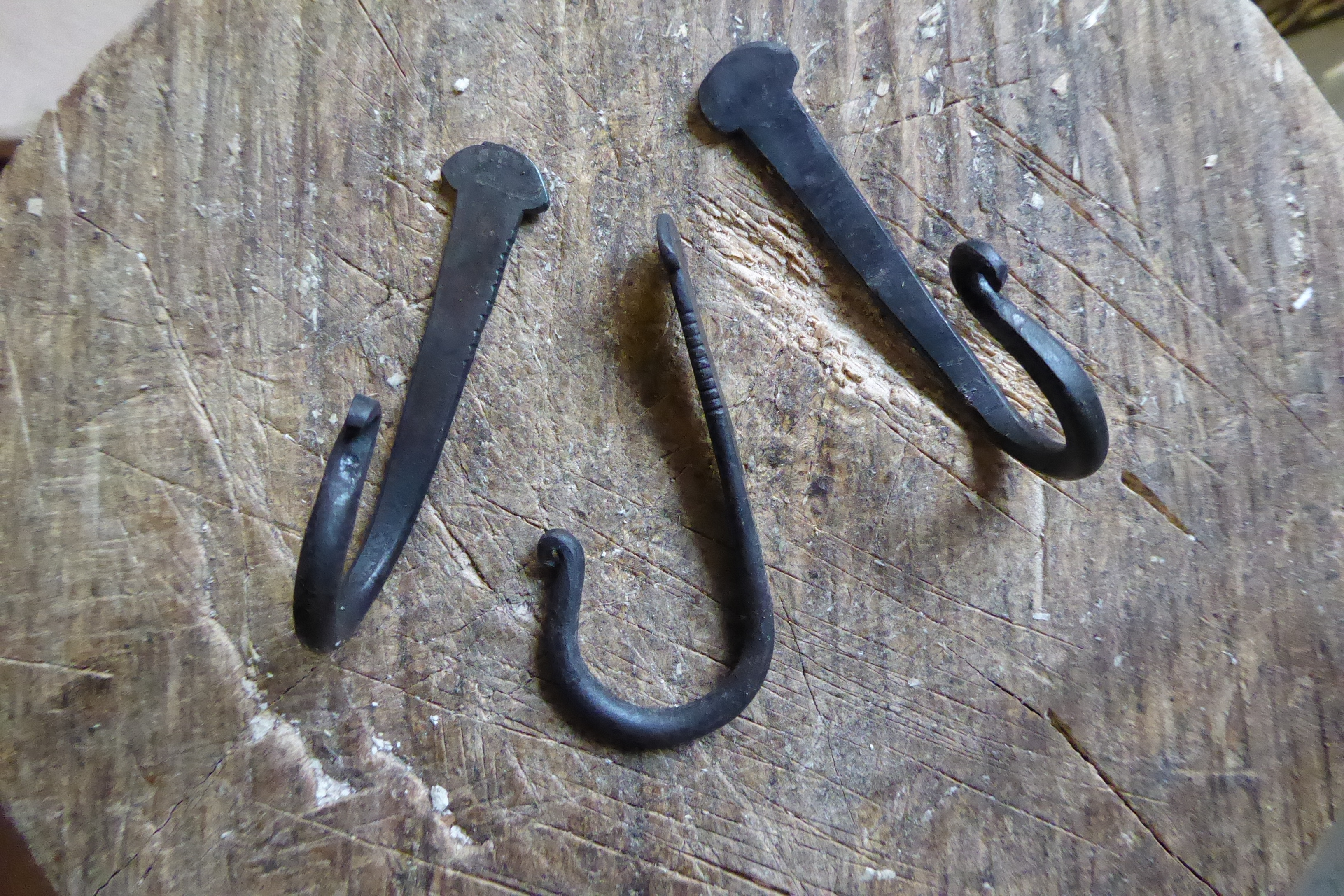
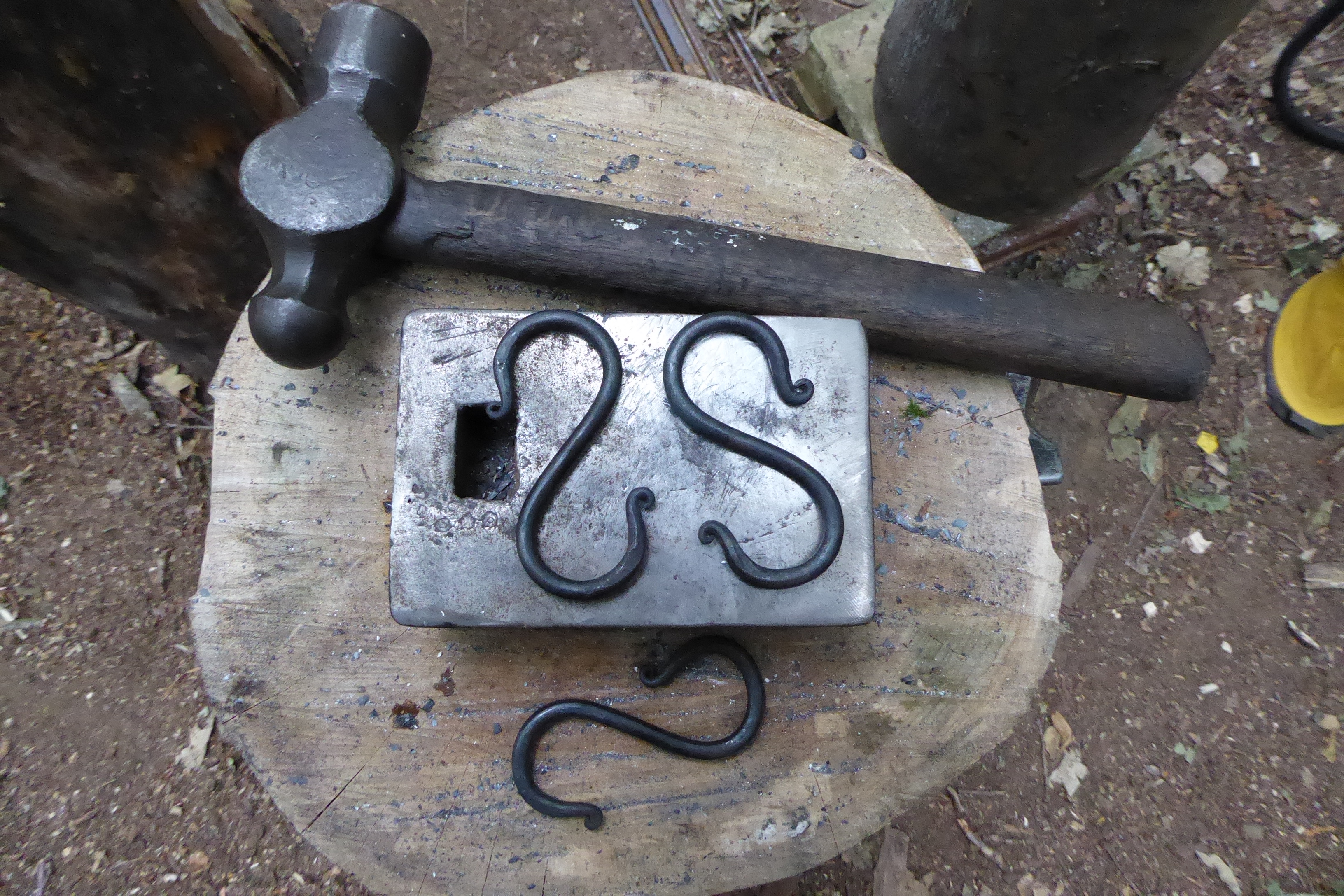
and my three finished S-hooks

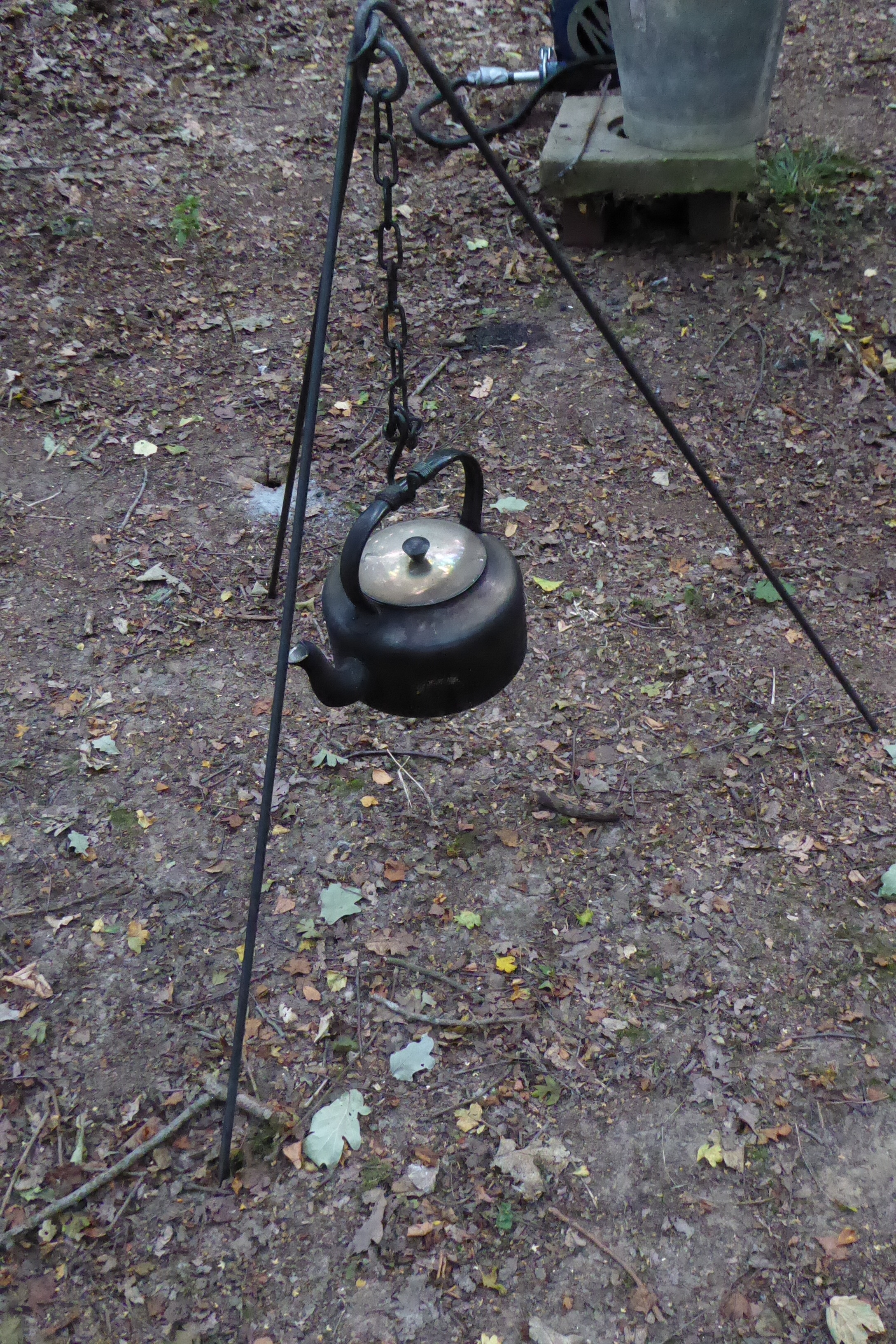
Phil went on to make a useful cooking tripod for suspending pots over a fire. They are three seperate legs with hooped rings which cleverly lock together at the top.

I had seen a demonstration of how to make small hooks with ordinary flat headed nails by flattening the top and putting a bend on them. Simon advised on adding a finial, so it was time to practice my new skills and have a go at some on my own. They will require a hole drilling in the top, then I hope to find a suitable log to split and make a rustic coat or cup or keyring hook rack.

In conclusion, well what a day to remember! We all got a huge amount of satisfaction, we got to try out our smithing equipment, learned lots of new skills to play with and had a good laugh too. Additionally for me, it was a joy to be able to host the event and share my woods with some great people by hosting the event and what could be a better location? Simon runs his blacksmithing courses from the old forge at Temple Newsham House, Leeds. If you fancy a one-to-one blackmith experience with him here are some links. He’s a great teacher and storyteller and I guarantee you will have a unique experience.

https://www.facebook.com/thelilliputforge/

http://lilliputforge.co.uk.websitebuilder.prositehosting.co.uk/

Be sure to read parts two and three of our weekend, following shortly


Leave a comment

Doing a few jobs, photography and taking it easy

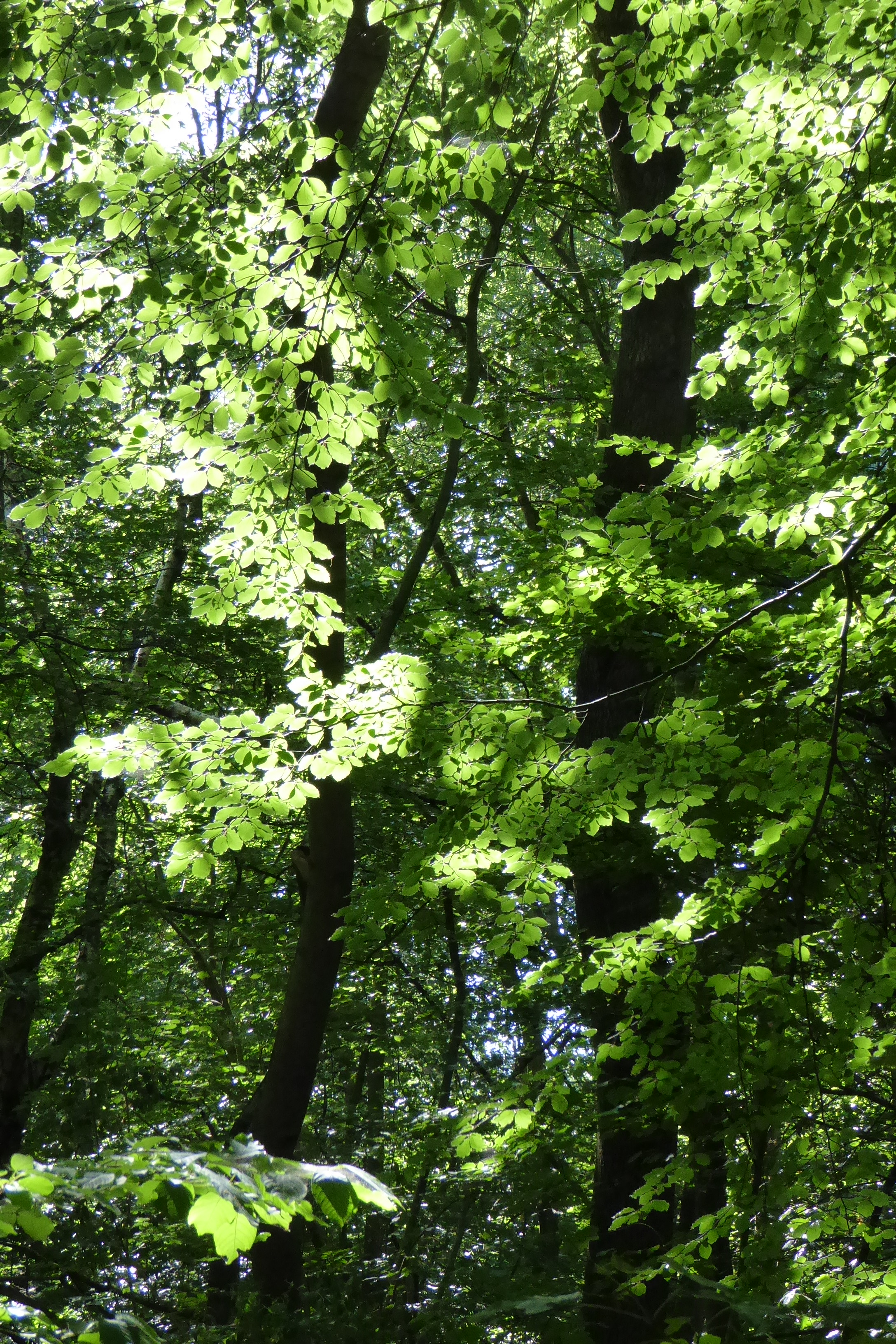
It’s just over two weeks since my last visit and although we had a few days of heavy rain, the ground is baked dry, as the hot arid weather continues. The trees seem to be coping well, just a few showing signs of dropping leaves early. The good news is that the ash dieback (chalara) that I noticed around this time last year, seems to have waned. I had expected to see an increase in saplings dying back as the disease spreads, but there are fewer new ones so far. Is it the hot dry weather that has temporarily slowed down it’s spread? Some of the previously infected ones even seem to have made some new growth.

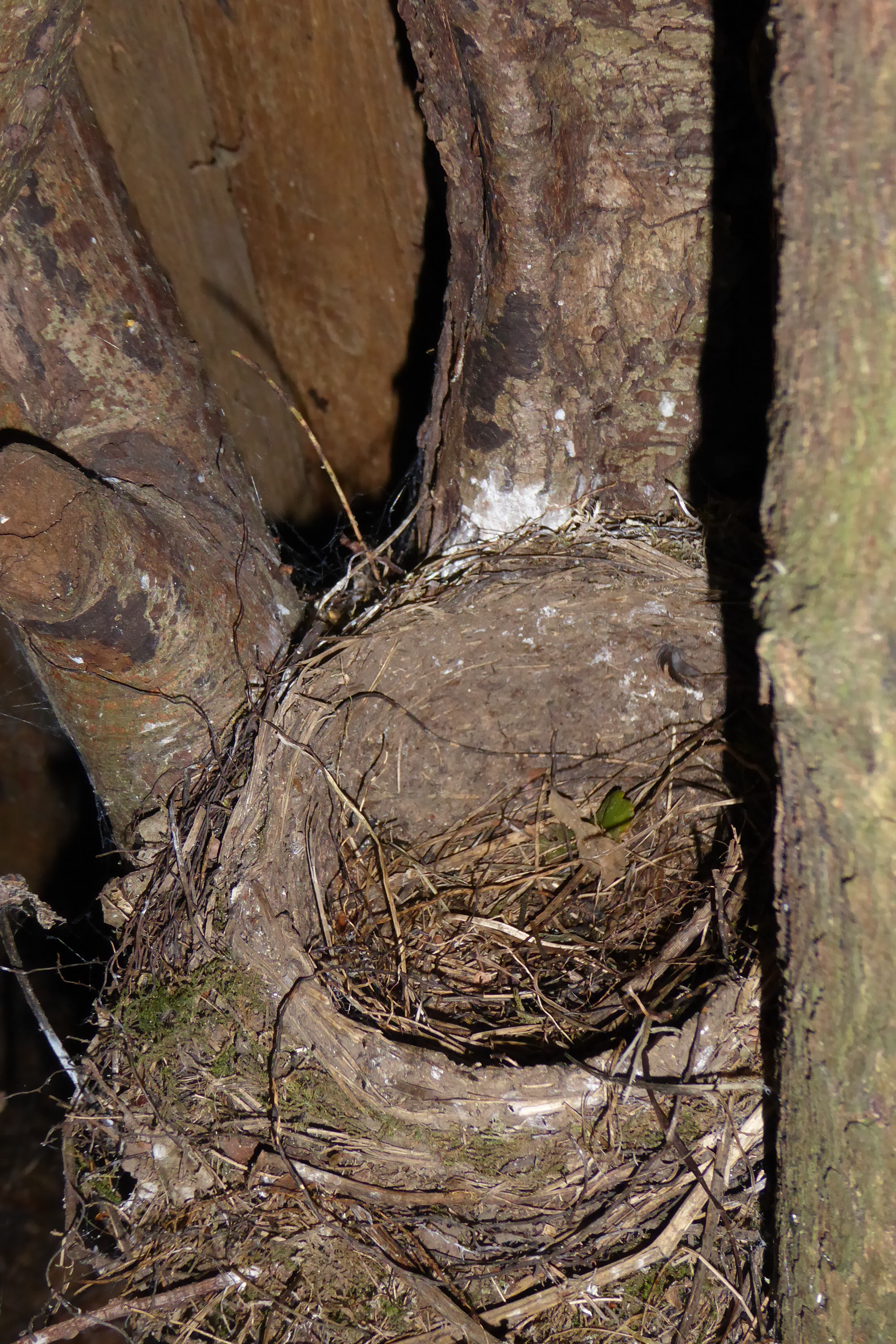
The new blackbird eggs I found last time have gone and the nest is empty. I doubt they could have hatched and fledged in such a short time so an guessing a predator suh as a grey squirrel, Jay etc has taken them.

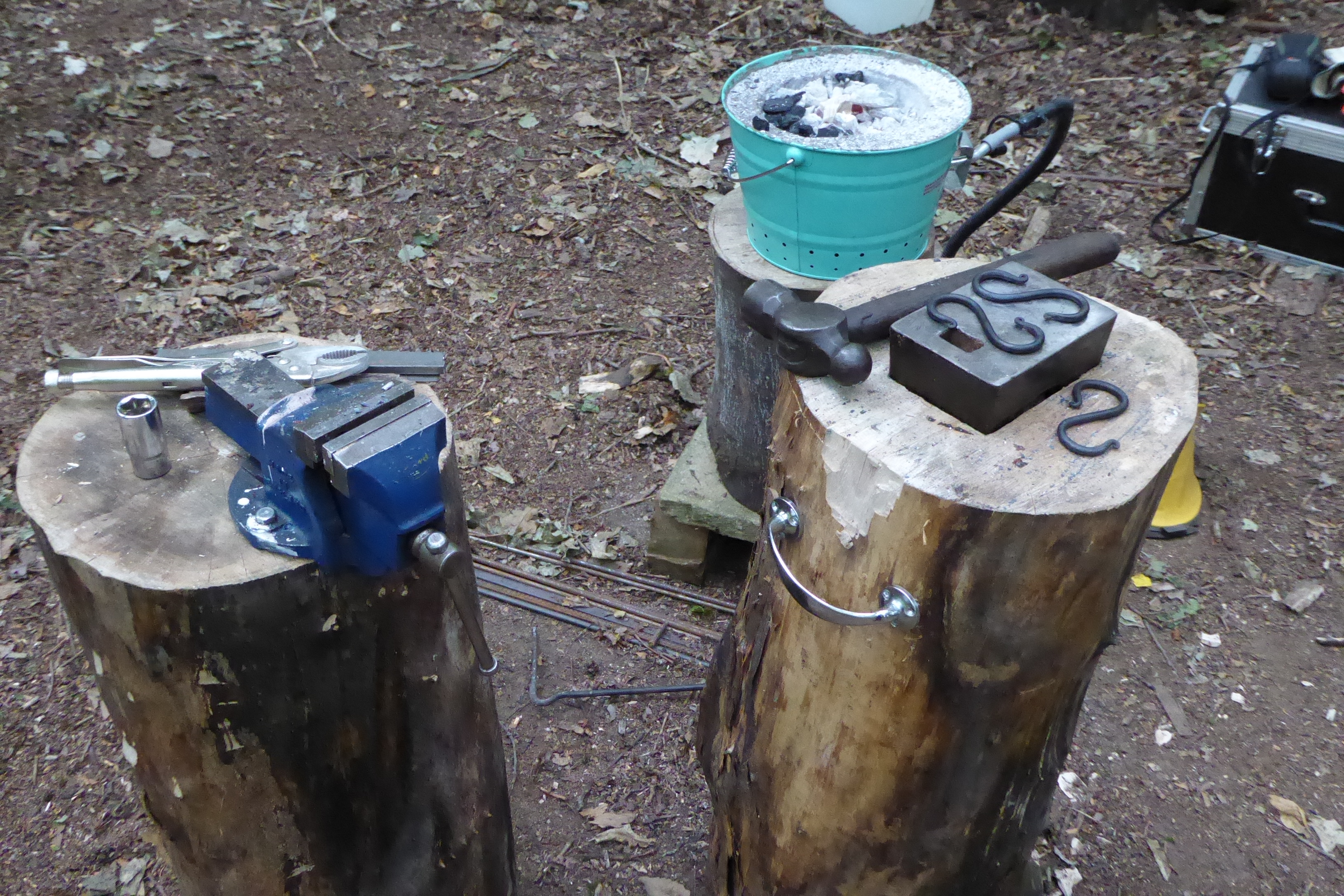
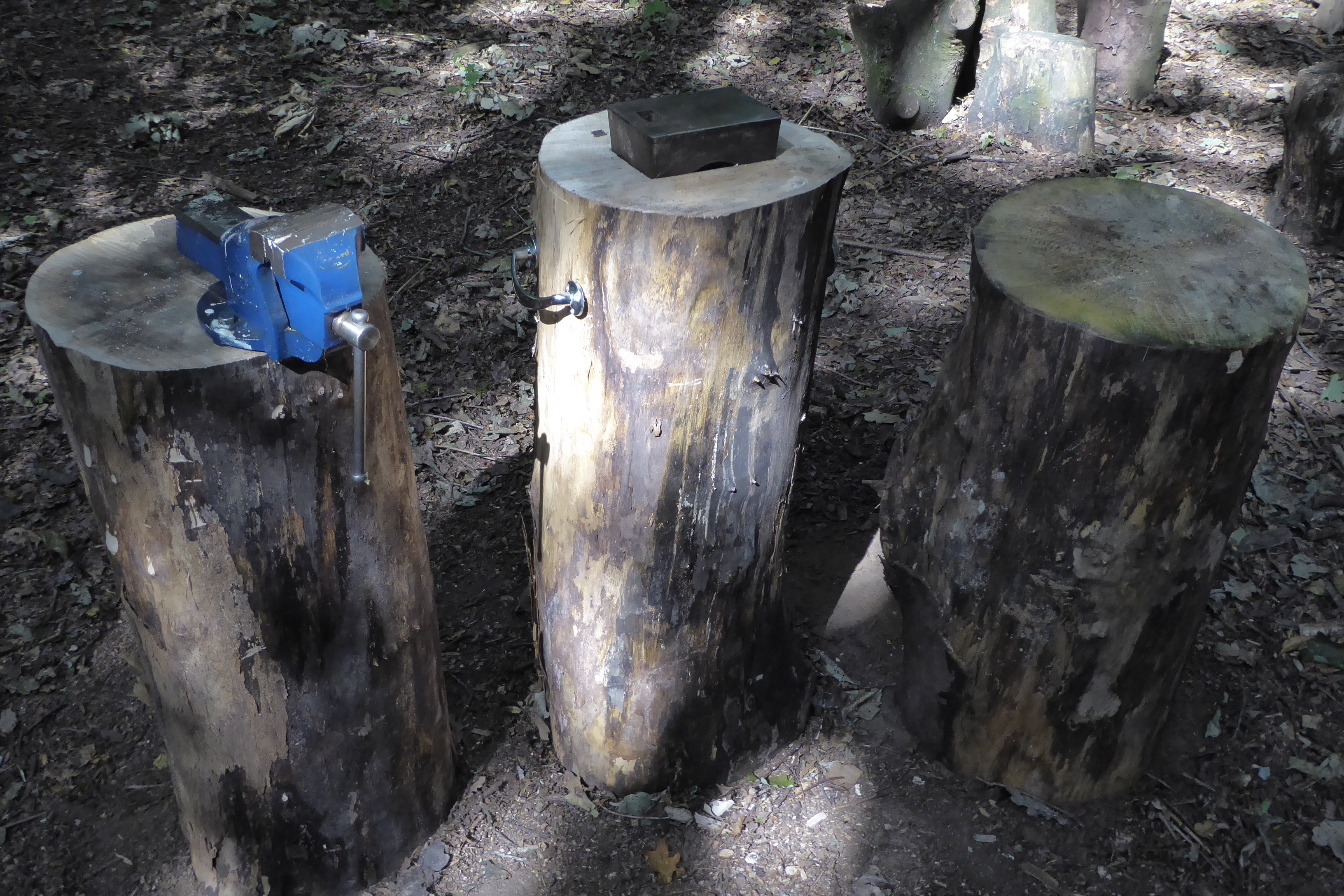
I had two main jobs on my list – to take some photos for the Woodland Trust fixed point project that I volunteer for and to prepare for the blacksmithing weekend coming up. Last time I prepared a stump for the potato weight anvil. The base has been polished up with an angle grinder flap wheel to create the working surface and I fitted a spare engineers’ vice to another stump. The handles on the anvil stump will also serve as handy racks for my hammers. This is how they look now. Can’t wait to try them on Saturday.

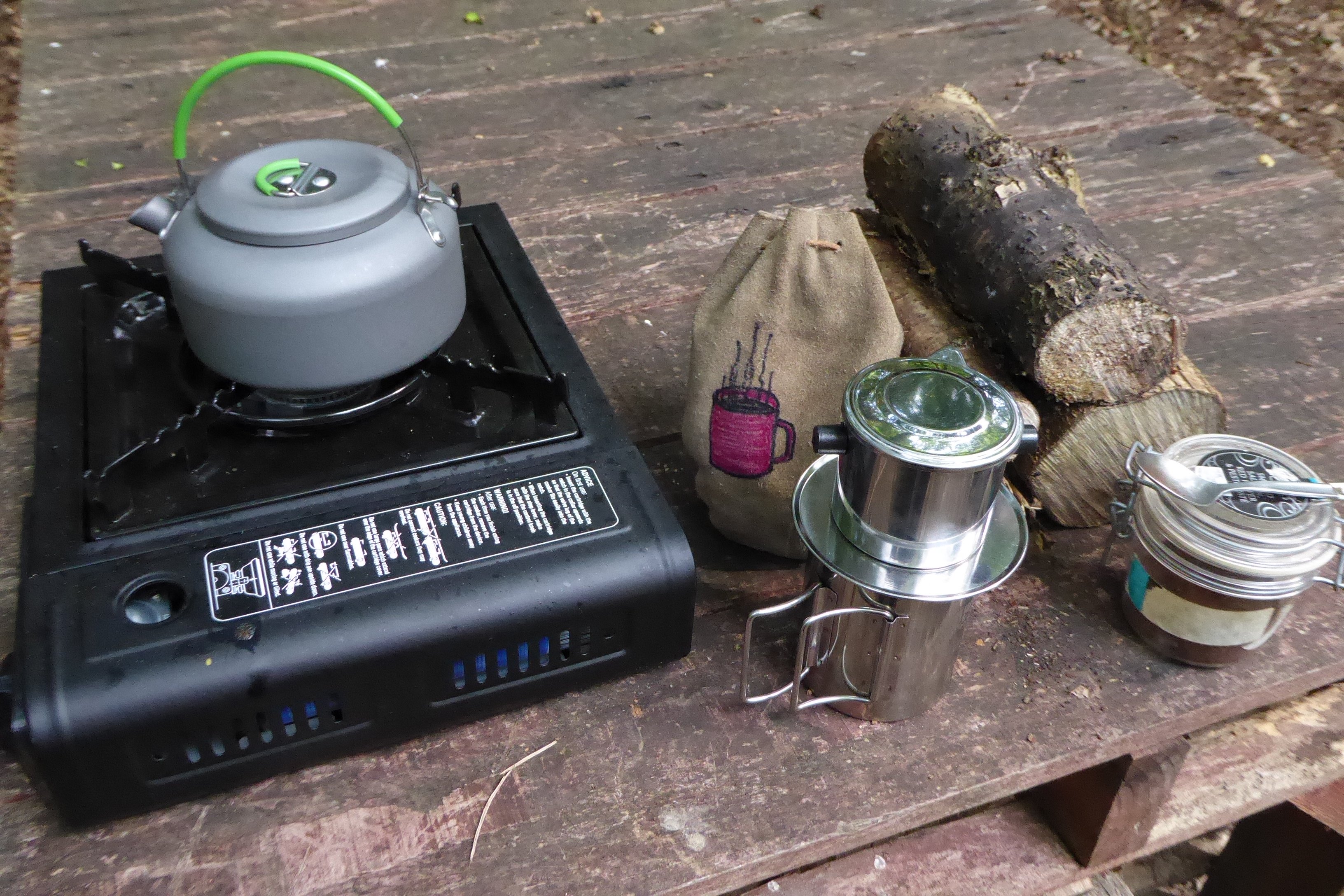
Time for a coffee break using my Vietnamese coffee filter which works a treat. The mini kettle and gas stove quickly boil enough water for a brew and is clean and convenient. I love making a fire but it’s time consuming and sometimes you want an easy option.

I spent an hour or so doing my volunteering photography, spotted a a buzzard – apparently there are a lot in the woods right now and I suspect some young ones have recently fledged and flown the nest. I met two woodland neighbours. It’s always good to catch up and talk woodland stuff. Some of us belong to a private facebook group specifically for ours woods and I had heard several people comment on the abundance of wasps this year. They were correct, they seemed to be crawling and hanging around everywhere. I filled a tray with water for the birds but it was an oasis for wasps. I’m keeping my fingers crossed for the dry weather to hold out for the weekend but it’s looking like a change is on it’s way. Be sure to come back here next week to see how the blacksmithing went.


2 Comments

Hot and dry and some new eggs

I arrived early this morning and it looked like someone had sprayed the woods with an atomiser. The faintest of wet on the leaves, that would evaporate in no time. It’s the driest and hottest summer we’ve had for decades. My woods are well drained and fairly dry at the best of times so it’s starting to worry me a little. Having said that the trees look in good health but much of the groundcover has wilted and died – apart from the bramble of course.

I had a few jobs in mind today. I’m planning a stay-over with some friends next month and we shall have a beginner’s blacksmithing session lead by my good friend and smithy – Simon. In preparation, I need to make a stump anvil. I have a 14lb potato weight which I’m told will serve as the anvil but need a stout stump to stand it on. It doesn’t need to look like a traditional anvil to be effective. Just something heavy and flat and made of steel or iron. There’s a big chunk of sycamore trunk that was felled over a year ago that I hadn’t got around to cutting up. So armed with chainsaw, I set-to cutting it up into suitable lengths. Surprisingly there is still a lot of water in the trunk due to it being left in one huge piece. The bark was peeling and as I ripped it off, I disturbed myriads of small creatures. Sorry.

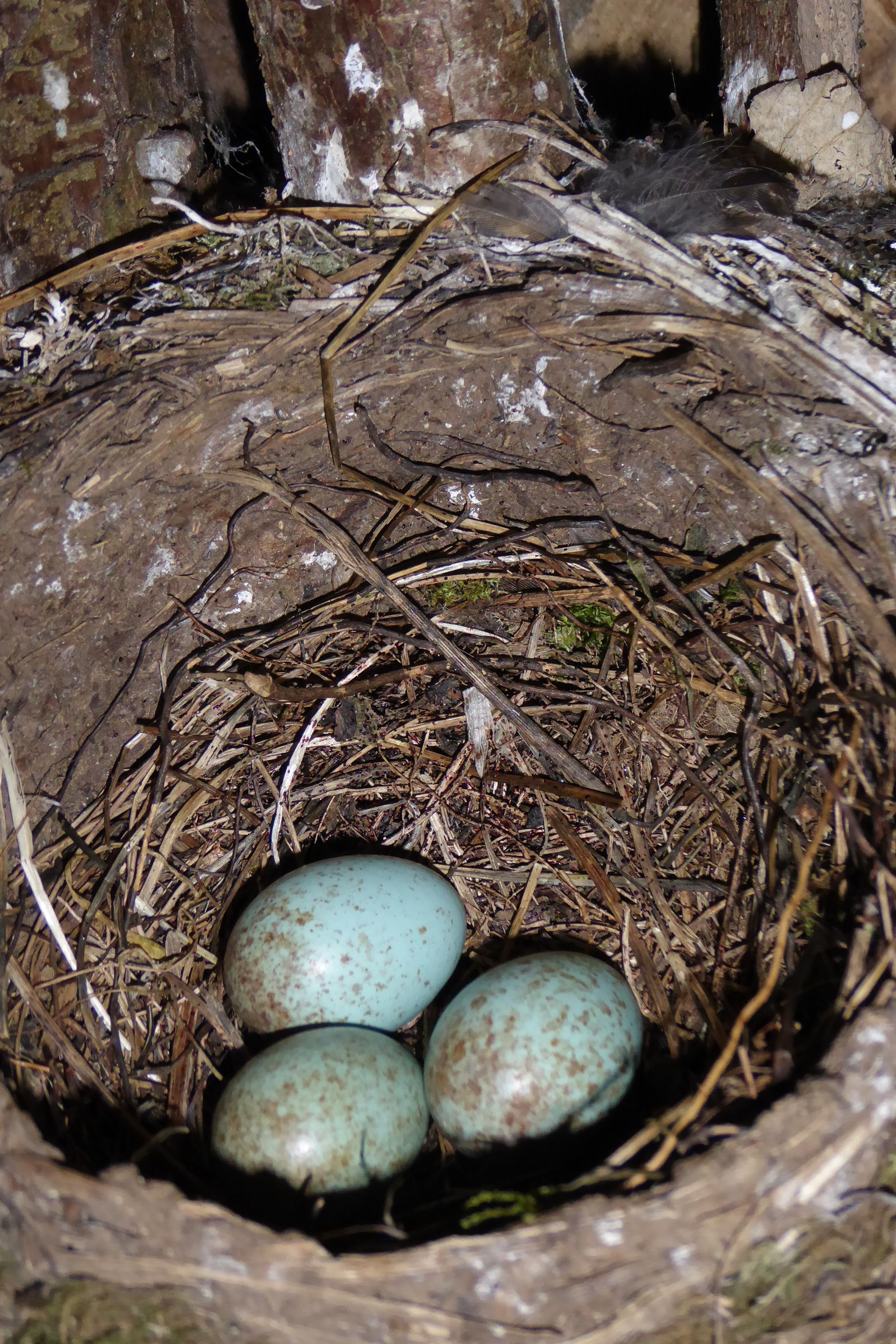
Around the back of the logshed is where the blackbirds nest was. Four young birds fledged a few weeks ago. There are three more new eggs in there. I know some birds have a second brood and wondered whether they might return. Here’s the proof and once again, I’m so pleased that my human intervention is prooving helpful to the wildlife. Hope they can find enough food when they hatch.

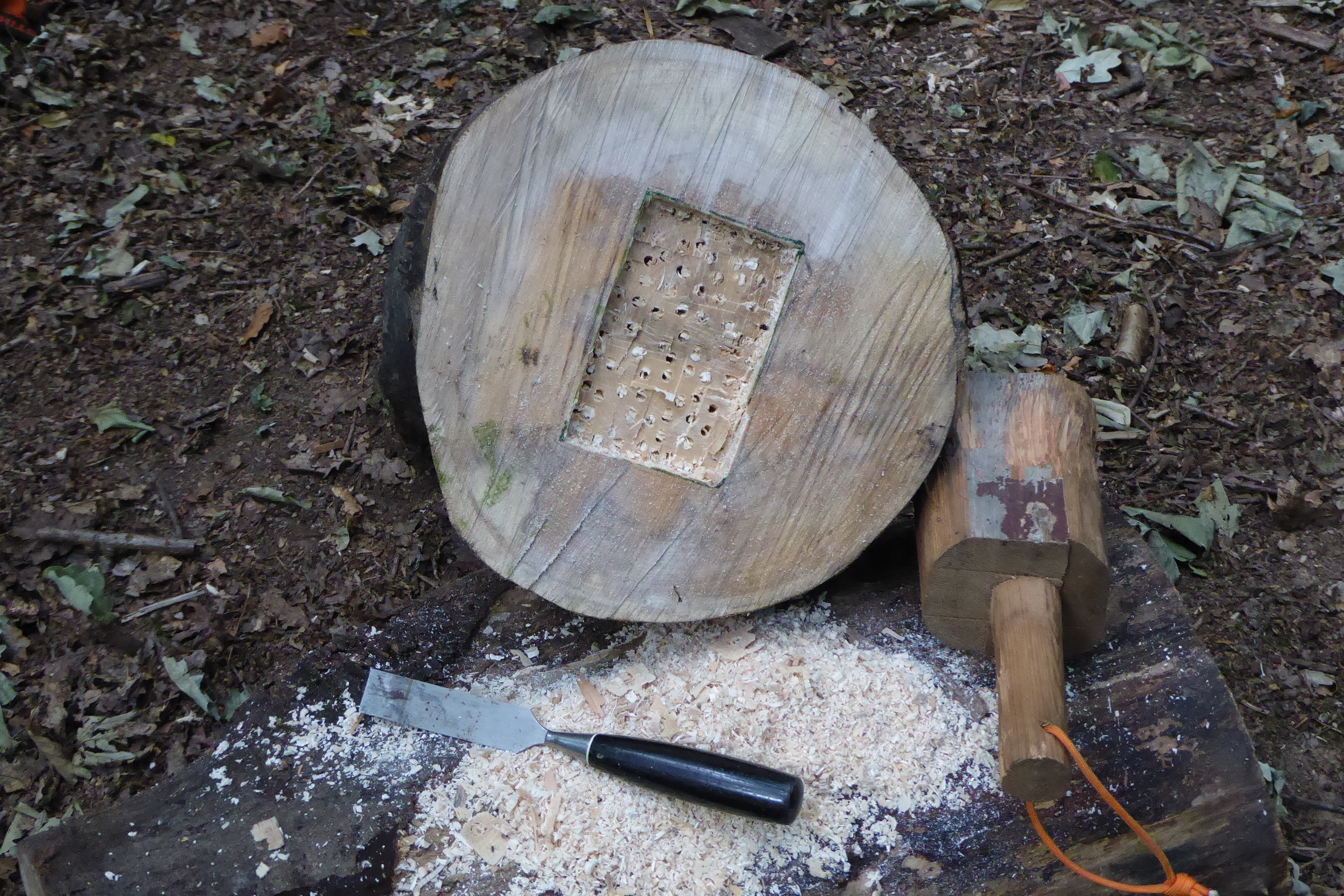
Back to the anvil. The plan was to cut a depression in the end of the stump to sit the potato weight in (upside down). I’d hoped to drill out the bulk with a brace and bit but drilling into the end grain was hopeless. The screw tip on the bit just wouldn’t bite so I resorted to drilling lots of small holes with my battery drill then hacking the wood out with a chisel. I needed to go down about 2 inches which was a long labourious job.

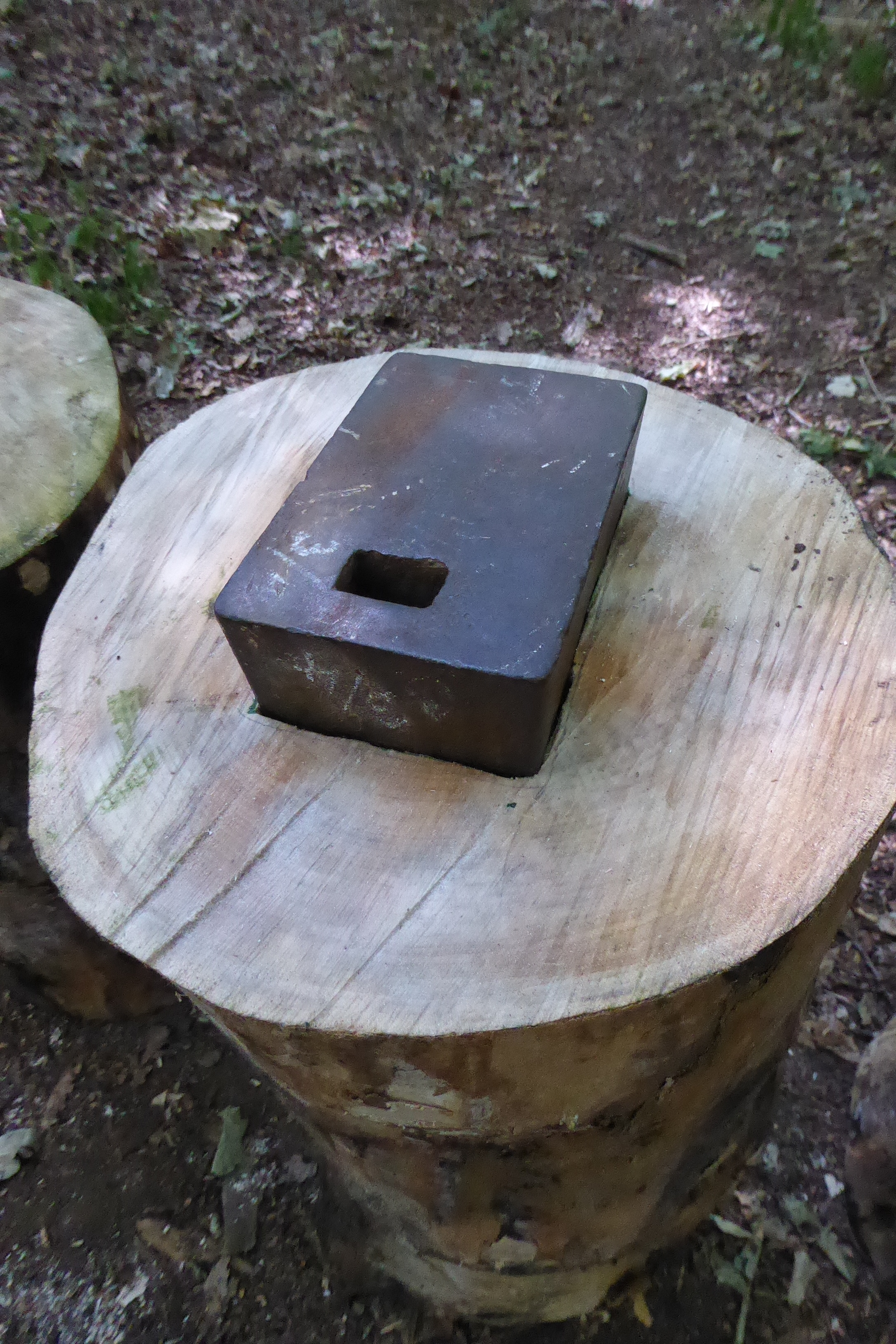
And here’s the potato weight sitting in it’s new stump. The surface of the weight will need smoothing off to make it useable as an anvil. That’s a job for home. It even has a pocket in the weight that could act as a hardy hole (Google it). How cool is that? Can’t wait to have a bash at some hot metal.

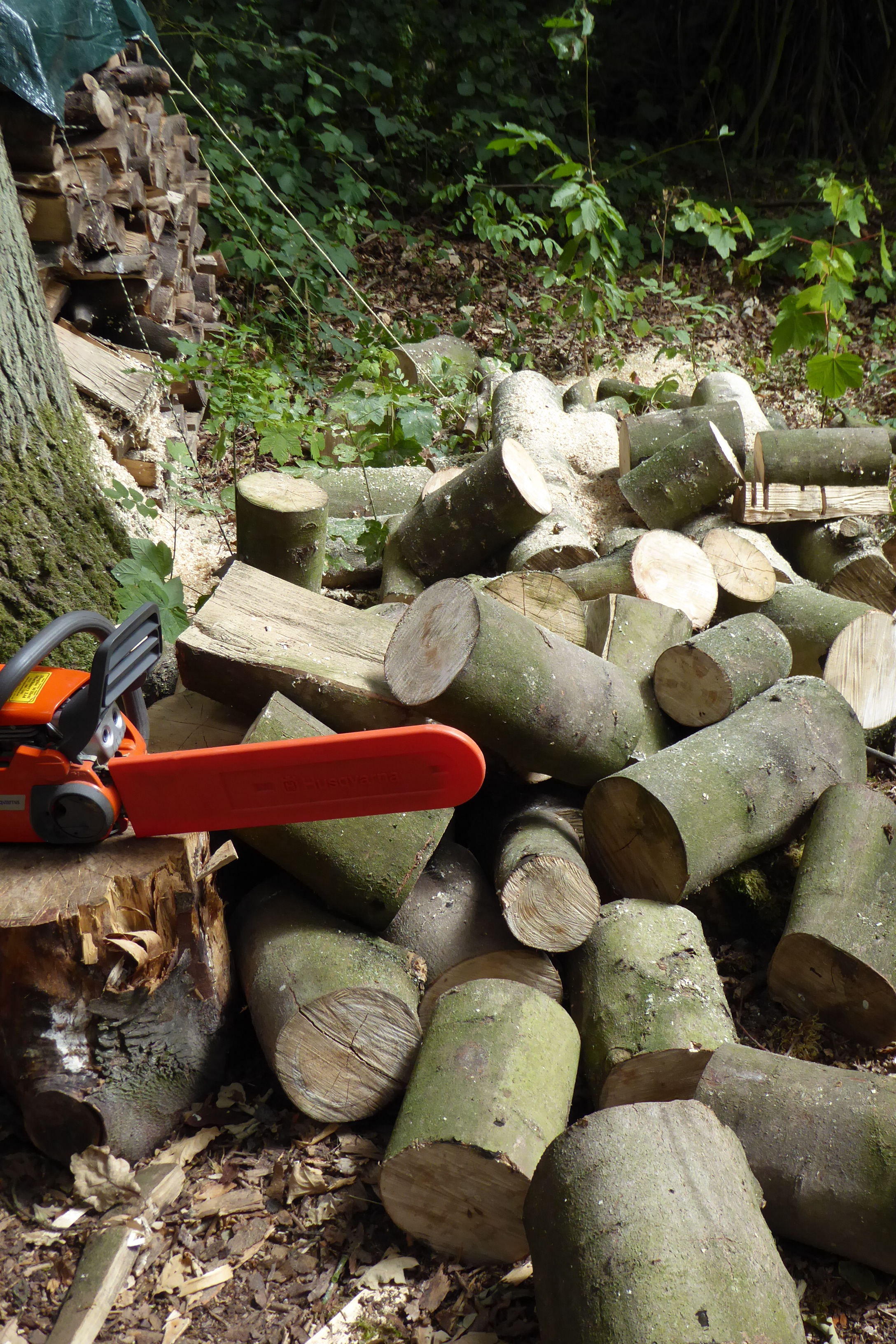
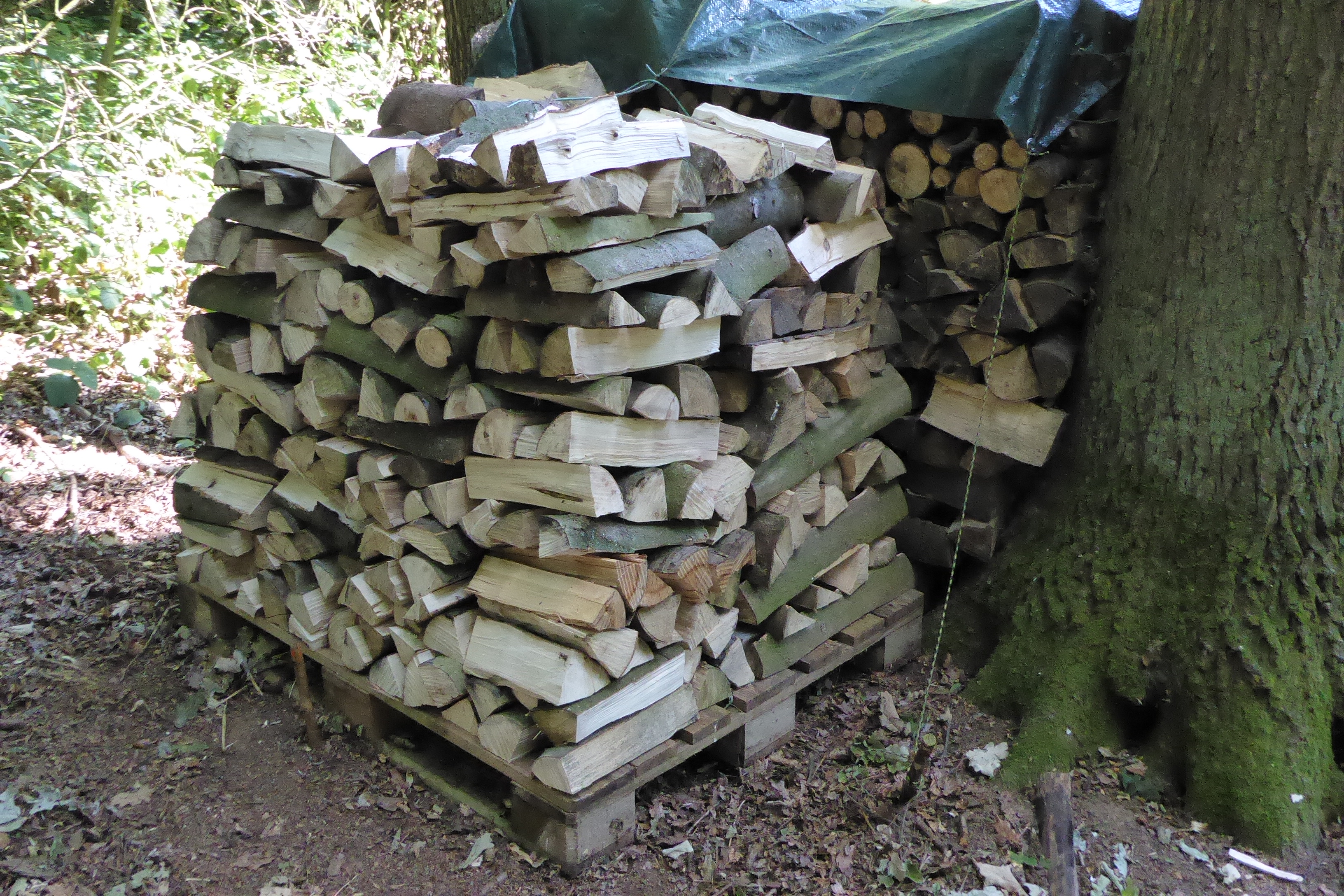
Whilst I had the chainsaw I decided to cut up some more logs that have been stacked since last winter. The hot dry weather has speeded up the seasoning process already.

My neighbours turned up and L. (Mrs Neighbour) who loves chopping wood, ended up turning most of this into firewood sized pieces which I added to my growing new stack. That was an unexpected bonus. Creating a log pile is one of life’s unpublicized pleasures, therapeutic and very satisfying. Everyone I know who has done it agrees. It should be available on the National Health. Till next time.